1
WELDMAX 185i
system of letters and numbers determined by the American Welding Society (AWS). The rating
system includes the minimum tensile strength of the finished weld, the weld position (flat, vertical,
horizontal, or overhead or a combination of two or more positions) and the flux type. Additional
information may be given. Each manufacturer has their individual name and terminology as well.
As there is no general recommendation that can be made about a particular electrode selection,
except for practice welds, a electrode designated by the AWS as E 6011, E 6013, E 7014, or E
7018 may be used, each having its own distinct features and purpose. These are among the most
common electrodes used in the industry and are not difficult to find. E 6011 electrodes are not as
smooth running as some of the other electrodes, but offer the advantage of being able to weld on
rusty metal and contaminated surfaces. It is widely used and requires very little skill to begin
using. This is not a particular endorsement of an E6011, rather a simple example of what may be
used in developing proficient technique. It is recommended that a variety of electrodes be used and
practiced with. Consultation with an experienced local welding supplier will help greatly in
determining what welding electrode is the best for your given situation. Many times, samples or
small packages of electrodes are available at relatively low cost to determine for yourself the best
electrode to use.
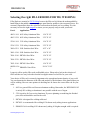
Stick Electrode Chart Example: E 60 1 3
Strength
60--60,000 psi,
70--70,000 psi
Weld Position
1--All positions: Flat, Vertical, Horizontal, & Overhead
2--Flat Position or Horizontal Fillets Only
3--Flat Position Only
Weld Characteristics
0--Non-low hydrogen, DC Reverse polarity
1--Non-low hydrogen, AC or DC Reverse polarity
2--Non-low hydrogen, AC or DC Straight polarity
3--Non-low hydrogen, AC or DC Either polarity
4--Non-low hydrogen, iron powder coating, AC or DC Reverse polarity
5--Low-hydrogen, DC Reverse polarity
6--Low-hydrogen, AC or DC Reverse polarity
7--Non-low hydrogen, iron powder coating, AC or DC Reverse polarity
8--Low hydrogen, iron powder coating, AC or DC Reverse polarity
Polarity Definition
electrode negative =straight polarity (typical stock machine setup)
electrode positive = reverse polarity
Be sure to observe the electrode manufacturer recommendations regarding polarity. If the weld
appears lumpy, porous or otherwise malformed, change the polarity of the ground cable and the
electrode holder cable. Many electrodes run with in reverse polarity, (DCEP) setting. A few run
with a straight polarity (DCEN). Some will run either way. For reverse polarity (DCEP) stick
welding, swap the electrode holder and ground cable connections.
www.longevity-inc.com