1
Application Considerations
•
Larger system supply and return header piping (which also reduces system pressure drop and
pump energy use).
Minimum water volume for a process application
If a chiller is attached to an on/off load such as a process load, it may be difficult for the controller
to respond quickly enough to the very rapid change in return solution temperature if the system
has only the minimum water volume recommended. Such systems may cause chiller low
temperature safety trips or in the extreme case evaporator freezing. In this case, it may be
necessary to add or increase the size of the mixing tank in the return line.
Multiple Unit Operation
Whenever two or more units are used on one chilled water loop, Trane recommends that their
operation be coordinated with a higher level system controller for optimum system efficiency and
reliability. The Trane Tracer system has advanced chilled plant control capabilities designed to
provide such operation.
Ice Storage Operation
An ice storage system uses the chiller to make ice at night when utilities generate electricity more
efficiently with lower demand and energy charges. The stored ice reduces or even replaces
mechanical cooling during the day when utility rates are at their highest. This reduced need for
cooling results in significant utility cost savings and source energy savings.
Another advantage of an ice storage system is its ability to eliminate chiller over sizing. A
“rightsized” chiller plant with ice storage operates more efficiently with smaller support equipment
while lowering the connected load and reducing operating costs. Best of all this system still
provides a capacity safety factor and redundancy by building it into the ice storage capacity for
practically no cost compared to over sized systems.
The Trane air-cooled chiller is uniquely suited to low temperature applications like ice storage
because of the ambient relief experienced at night. Chiller ice making efficiencies are typically
similar to or even better than standard cooling daytime efficiencies as a result of night-time drybulb ambient relief.
Standard smart control strategies for ice storage systems are another advantage of the RTAE
chiller. The dual mode control functionality is integrated right into the chiller. Trane Tracer building
management systems can measure demand and receive pricing signals from the utility and decide
when to use the stored cooling and when to use the chiller.
Unit Placement
Setting The Unit
A base or foundation is not required if the selected unit location is level and strong enough to
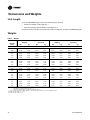
support the unit’s operating weight. (See “Weights,” p. 38.)
For a detailed discussion of base and foundation construction, see the sound engineering bulletin
or the unit IOM. Manuals are available through online product portal pages or from your local
office.
HVAC equipment must be located to minimize sound and vibration transmission to the occupied
spaces of the building structure it serves. If the equipment must be located in close proximity to
a building, it should be placed next to an unoccupied space such as a storage room, mechanical
room, etc. It is not recommended to locate the equipment near occupied, sound sensitive areas of
the building or near windows. Locating the equipment away from structures will also prevent
sound reflection, which can increase sound levels at property lines or other sensitive points.
Isolation and Sound Emission
Structurally transmitted sound can be reduced by elastomeric vibration eliminators. Elastomeric
isolators are generally effective in reducing vibratory noise generated by compressors, and
RLC-PRC042D-EN
11