1
MATERIAL SAFETY DATA SHEET
Page : 3/4
Date Revised : Jun.1, 2007
Date Issued : Dec.1, 2003
MSDS No. F-01221
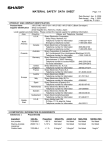
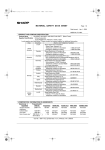
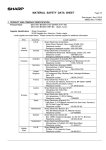
Exposure Limit Values
OSHA-PEL(USA)
ACGIH-TLV(USA)
Personal Protective Equipment
Respiratory Protection
Hand Protection
Eye Protection
Skin Protection
Other Protective Equipment
: 15mg/m3 (Total Dust), 5mg/m3 (Respirable Dust)
: 10mg/m3 (Total Dust), 3mg/m3 (Respirable Dust)
: Not required under intended use.
: Not required under intended use.
: Not required under intended use.
: Not required under intended use.
: Use of a dust mask and goggles are recommended when handling a large
quantity of toner or during long term exposure, as with any non-toxic dust.
9.PHYSICAL AND CHEMICAL PROPERTIES
Appearance
Physical State : Solid
Form : Powder
Color : Black
Ph
: Not applicable
Boiling / Melting Point
: Not applicable
Softening Point(°C)
: 100 - 130
Flash Point(°C)
: Not applicable
lgnition Point(°C )
: > 350
Explosion Properties
: No data
Density(g/cm³)
: 1.1 (bulk density : 0.4)
Solubility in Water
: Negligible
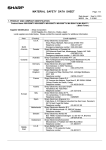
10.STABILITY AND REACTIVITY
Stability
Hazardous Reactions
Conditions to Avoid
Materials to Avoid
Hazardous Decomposition Products
Further Information
Odor : odorless
: Stable
: Dust explosion, like most finely divided organic powders.
: Electric discharge, throwing into fire.
: Oxidizing Materials
: CO, CO2 and NOX
: None
11.TOXICOLOGICAL INFORMATION
Acute Toxicity
Ingestion(oral)
: LD50 > 2000mg/kg (Rats)
Inhalation
: LC50 > 5.0mg/L
Eye irritation
: Not an irritant (Rabbits)
Skin irritation
: Not an irritant (Rabbits)
Skin sensitizer
: No sensitization
Mutagenicity
: Negative (Ames Test)
Carcinogenicity : In 1996 the IARC reevaluated carbon black as a Group 2B carcinogen (possible human
carcinogen). This classification is given to chemicals for which there is inadequate human
evidence, but sufficient animal evidence on which to base an opinion of carcinogenicity. The
classification is based upon the development of lung tumors in rats receiving chronic inhalation
exposures to free carbon black at levels that induce particle overload of the lung. Studies
performed in animal models other than rats did not show any association between carbon black
and lung tumors. Moreover, a two-year cancer bioassay using a typical toner preparation, where
carbon black is bound in a resin matrix, demonstrated no association between toner exposure
and tumor development in rats.