1
GETTING STARTED
Basic Setup
Channel Setup
1.
Ensure all power is turned off on your mixer. To totally
ensure this, the AC cable should not be connected to
the unit.
1.
2.
All faders and level controls should be set at the lowest level and all channels switched off to ensure no
sound is inadvertently sent through the outputs when
the device is switched on. All levels can be altered to
acceptable degrees after the device is turned on.
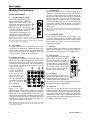
To ensure the correct audio level of the input channel
is selected, each of the Mixer’s Channel’s ON buttons should be disengaged (which should turn the
corresponding LED indicator off – otherwise go back
and try again), as well as the SOLO buttons on each
channel and on the master section, and the 2T RTN
"To Ctrl Rm" button.
2.
Ensure the channel you wish to set has a signal sent
to it similar to the signal that will be sent when in
common use. For example, if the channel has a microphone connected to it, then you should speak or
sing at the same level the performer normally would
during a performance; if a guitar is plugged into the
channel, then the guitar should also be strummed as
it normally would be (and so on). This ensures levels
are completely accurate and avoids having to reset
them later.
3.
Move the Channel fader and Maser fader to around
the 0 dB mark.
4.
Turn the Channel ON.
5.
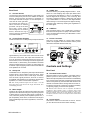
Pushing the channel’s SOLO button and releasing the
Pre/Post button on the CTRL RM section will send the
pre-fader signal of the activated channel to the Control
Room / Phones mixing bus and the Level Meter will
display the Control Room’s signal properties.
6.
Set the gain so the level meter indicates the audio
level is around 0 dB.
7.
This channel is now ready to be used; you can stop
making the audio signal.
8.
You can now repeat the same process for other channels if you wish.
3.
Plug all necessary instruments and equipment into the
device’s various inputs as required. This may include
line signal devices, such as keyboards and drum
machines, as well as microphones and/or guitars,
keyboards, etc.
4.
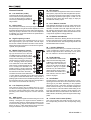
Plug any necessary equipment into the device’s various outputs. This could include amplifiers and speakers, monitors, signal processors, and/or recording
devices.
5.
Plug the supplied AC cable into the AC inlet on the
back of the device and a power outlet of a suitable
voltage.
6.
Turn the power switch on.
7.
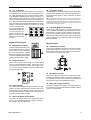
Insert the provided USB cord into the Helix Board 17's
USB jack, and your personal computer's USB jack.
Provided your computer is switched on and complies
with the requirements described later in this manual,
your computer should automatically recognize your
Helix Board 17. For more information on using the USB
interface, please refer to page 14 of this manual.
HELIX BOARD 17
5