1
Using an Internal Source
To use di/SampleClock with an internal source, specify the signal source
and the polarity of the signal. Use the following signals as the source:
•
AI Sample Clock
•
AI Convert Clock
•
AO Sample Clock
•
Counter n Internal Output
•
Frequency Output
•
DI Change Detection Output
Several other internal signals can be routed to di/SampleClock. Refer to the
Device Routing in MAX topic in the NI-DAQmx Help or the LabVIEW Help
in version 8.0 or later for more information.
The NI-DAQmx Help is available after installation from Start»
All Programs»National Instruments»NI-DAQ»NI-DAQmx Help.
To view the LabVIEW Help, in version 8.0 or later, select Help»
Search the LabVIEW Help in LabVIEW. Alternately, to download
the LabVIEW Help, go to ni.com/manuals.
Using an External Source
You can route the following signals as di/SampleClock:
•
Any PFI terminal
•
Analog Comparison Event (an analog trigger)
You can sample data on the rising or falling edge of di/SampleClock.
Routing DI Sample Clock to an Output Terminal
You can route di/SampleClock to any output PFI terminal. The PFI
circuitry inverts the polarity of di/SampleClock before driving the PFI
terminal.
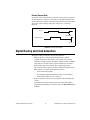
Digital Waveform Generation (Correlated Output)
With a hardware-timed generation, a digital hardware signal controls the
rate of the generation. This signal can be generated internally on the chassis
or provided externally.
Hardware-timed generations have several advantages over software-timed
acquisitions:
•
The time between samples can be much shorter.
•
The timing between samples can be deterministic.
Hardware-timed operations must be buffered.
© National Instruments Corporation
37
NI cDAQ-9172 User Guide and Specifications