1
FPC Description
•
•
•
•
•
•
•
•
•
•
•
•
•
•
•
•
•
•
•
•
•
•
•
•
•
•
•
•
•
•
•
•
•
•
•
•
•
•
•
•
•
•
•
•
•
•
•
•
•
•
•
•
•
•
•
•
•
•
FPC Description
2
FPC Installation Instructions
The FPCs on a router house the Physical Interface Cards (PICs), which connect the router to
network media. The I/O Manager ASIC or ASICs on the FPC accepts incoming data packets
from the PICs on the FPC and divides each packet into 64-byte cells. The cells cross the
midplane to the SFM, where another ASIC decides how to distribute them among the
memory buffers located on and shared by all installed FPCs. After the SFM decides how to
forward a packet, the I/O Manager ASIC or ASICs on the FPC reassembles the corresponding
data cells back into network-packet form and passes the packet to the appropriate PIC for
transmission to the network.
FPCs are hot-insertable and hot-removable. When you remove or install an FPC, packet
forwarding halts for about 200 ms while the Packet Forwarding Engine adjusts to the change
in the amount of memory available in the pool located on and shared by all FPCs. When you
install an FPC into a functioning router, the Routing Engine downloads the FPC software, the
FPC runs its diagnostics, and the PICs housed on the FPC are enabled. Forwarding continues
uninterrupted during this process.
An FPC can be installed into any FPC slot, regardless of the PICs it contains, and any
combination of slots can be used. If a slot is empty, you must install a blank FPC panel to
shield it, so that cooling air can circulate properly throughout the card cage.
For a description of the FPCs supported on each router, see the following sections:
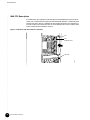
! M20 FPC Description on page 3
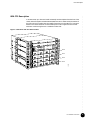
! M40 FPC Description on page 4
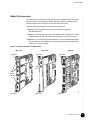
! M40e FPCs Description on page 5
! M160 FPCs Description on page 7