1
Operation Guide 5263
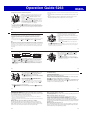
Charging the Watch
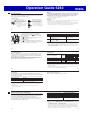
The face of the watch is a solar panel that generates power from light. The generated
power charges a built-in rechargeable battery, which powers watch operations. The
watch charges whenever it is exposed to light.
Charging Guide
Whenever you are not
wearing the watch, be sure
to leave it in a location
where it is exposed to light.
x Best charging
performance is achieved
by exposing the watch to
light that is as strong as
possible.
When wearing the watch,
make sure that its face is
not blocked from light by the
sleeve of your clothing.
x The watch may enter a
sleep state (page E-16) if
its face is blocked by your
sleeve even only partially.
Warning!
Leaving the watch in bright light for charging can cause it to become quite hot.
Take care when handling the watch to avoid burn injury. The watch can become
particularly hot when exposed to the following conditions for long periods.
x On the dashboard of a car parked in direct sunlight
x Too close to an incandescent lamp
x Under direct sunlight
Important!
x Keep the watch in an area normally exposed to bright light when storing it for long
periods. This helps to ensure that power does not run down.
x Storing the watch for long periods in an area where there is no light or wearing it in
such a way that it is blocked from exposure to light can cause power to run down.
Make sure that the watch is exposed to bright light whenever possible.
E-10
E-11
Hand Movement and Function Status
Power Levels
B
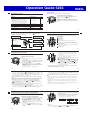
You can get an idea of the watch’s power level by
observing the movement of the x Second Hand in the
Timekeeping Mode. See “Hand Movement and Function
Status” (page E-13).
If the x Second Hand is moving normally at one-second
intervals, power is at Level 1.
+
@
5
Low Battery Alert
If the x Second Hand is moving at two-second intervals,
power is at Level 2, which is quite low. Expose the watch to
light as soon as possible so it can charge.
Moves at two-second
intervals.
Level Hand Movement
Function Status
1
Normal.
2
Beeper, time calibration signal
x Second Hand moving at two-second
reception, and countdown timer
intervals.
m Day Indicator changes to 1 (home position). operation disabled.
All functions enabled.
3
x Second Hand stopped.
z Hour Hand and c Minute Hand stopped
at 12 o’clock.
All functions disabled.
x When power drops to Level 3, all functions will be disabled but the watch will
continue to keep time internally for about one week. If you recharge the battery
sufficiently during this period, the analog hands will move automatically to the
correct setting and regular timekeeping will resume. After one week, all settings
(including timekeeping) will be cleared. Recharging the battery will reset all settings
to their initial factory defaults.
E-12
E-13
Power Recovery Mode
Charging Times
The watch is designed to go into a power recovery mode that stops hand operation
temporarily whenever power suddenly drops below a certain level due to overuse
of the alarm tone over a short period. Note that all operations are disabled while the
watch is in the power recovery mode.
The hands will move to the correct positions and the watch will resume normal
operation after power recovers (in about 15 minutes). Putting the watch in a location
where it is exposed to light will help power to recover sooner.
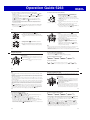
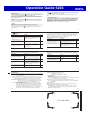
Exposure Level (Brightness)
Daily
Operation
*1
Level Change *2
Level 3
Level 2
Level 1
Outdoor sunlight (50,000 lux)
8 minutes
2 hours
Window sunlight (10,000 lux)
30 minutes
6 hours
85 hours
Window sunlight on cloudy day
(5,000 lux)
48 minutes
8 hours
138 hours
8 hours
92 hours
–––
Indoor fluorescent lighting (500 lux)
23 hours
* 1 Approximate exposure each day to generate power for normal daily operation.
* 2 Approximate amount exposure time required to take power up one level.
x The above exposure times all are for reference only. Actual exposure times depend
on lighting conditions.
x For details about the operating time and daily operating conditions, see the “Power
Supply” section of the Specifications (page E-77).
E-14
E-15
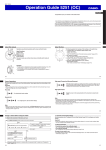
Power Saving
Power Saving enters a sleep state automatically whenever the watch is left for a
certain period in an area where it is dark. The table below shows how watch functions
are affected by Power Saving.
x There actually are two sleep state levels: “second hand sleep” and “function sleep”.
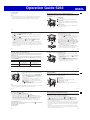
Elapsed Time in Dark
Operation
60 to 70 minutes (second hand
sleep)
x Second Hand only stopped at 12 o’clock, all other
functions enabled
6 or 7 days (function sleep)
x All functions, including analog timekeeping, disabled
x Internal timekeeping maintained
To recover from the sleep state
Move the watch to a well-lit area or press any button.
x The watch will not enter a sleep state between 6:00 a.m. and 9:59 p.m. If the watch
is already in a sleep state when 6:00 a.m. arrives, however, it will remain in the
sleep state.
x The watch will not enter a sleep state while it is in the Stopwatch Mode or
Countdown Timer Mode.
E-16
Radio Controlled Atomic Timekeeping
This watch receives a time calibration signal and updates its time setting accordingly.
However, when using the watch outside of areas covered by time calibration signals,
you will have to adjust the settings manually as required. See “Configuring Current
Time and Date Settings Manually” (page E-38) for more information.
This section explains how the watch updates its time settings when the city code
selected as the Home City is in Japan, North America, Europe, or China, and is one
that supports time calibration signal reception.
E-17
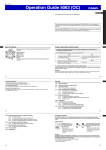
If your Home City Code setting is this:
LONDON (LON), PARIS (PAR), ATHENS (ATH)
HONG KONG (HKG)
TOKYO (TYO)
HONOLULU (HNL), ANCHORAGE (ANC),
LOS ANGELES (LAX), DENVER (DEN),
CHICAGO (CHI), NEW YORK (NYC)
The watch can receive the signal from
the transmitter located here:
Anthorn (England), Mainflingen (Germany)
Shangqiu City (China)
Fukushima (Japan), Fukuoka/Saga (Japan)
Fort Collins, Colorado (United States)
Important!
x The areas covered by HONOLULU (HNL) and ANCHORAGE (ANC) are quite far
from the calibration signal transmitters, so certain conditions may cause reception
problems.
x When HONOLULU (HNL) or HONG KONG (HKG) is selected as the Home City,
only the time and date are adjusted according to the time calibration signal. You
need to switch manually between standard time and daylight saving time (DST) if
required. See “To toggle the Home City time between standard time and daylight
saving time” (page E-36) for information about how to do this.
E-18
E-19