1
LANCOM L-460agn dual Wireless
Features as of: LCOS 9.00
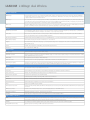
WLAN
bandwidth limitation per WLAN client
Maximum transmit and receive bandwith and an individual VLAN ID can be assigned to each WLAN client (MAC address)
bandwidth limitation per SSID
Maximum transmit and receive bandwith can be assigned to each SSID
Broken link detection
If the link of a chosen LAN interface breaks down, a WLAN module can be deactivated to let the associated clients search for a new base station
Background scanning
Detection of rogue AP's and the channel information for all WLAN channels during normal AP operation. The Background Scan Time Interval defines
the time slots in which an AP or Router searches for a foreign WLAN network in its vicinity. The time interval can be specified in either milliseconds,
seconds, minutes, hours or days
Client detection
Rogue WLAN client detection based on probe requests
IEEE 802.1X supplicant
Authentication of an access point in WLAN client mode at another access point via IEEE 802.1X (EAP-TLS, EAP-TTLS and PEAP)
Layer-3 Tunneling
Layer-3 Tunneling in conformity with the CAPWAP standard allows the bridging of WLANs per SSID to a separate IP subnet. Layer-2 packets are
encapsulated in Layer-3 tunnels and transported to a LANCOM WLAN controller. By doing this the access point is independent of the present
infrastructure of the network. Possible applications are roaming without changing the IP address and compounding SSIDs without using VLANs.
IEEE 802.11u
The WLAN standard IEEE 802.11u (Hotspot 2.0) allows for a seamless transition from the cellular network into WLAN hotspots. Authentication
methods using SIM card information, certificates or username and password, enable an automatic, encrypted login to WLAN hotspots - without
the need to manually enter login credentials.
Auto WDS**
Auto WDS allows wireless integration of access points in existing WLAN infrastructure, including managment via WLAN controller.
Note
The effective distances and transmission rates that can be achieved are depending of the site RF conditions
**) Note
Only in installations with WLAN controller
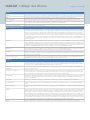
LANCOM Active Radio Control
Client Steering*
WLAN clients are directed actively to the best available access point to provide the best overall load balancing and the highest possible bandwidth
for each client. Client Steering can be based on client number, frequency band, and signal strength.
Band Steering
Steering of WLAN clients towards the 5 GHz frequency band by restricting the access to the 2.4 GHz band.
RF Optimization*
Automatic selection of optimal WLAN channels. Due to reduced channel overlaps, WLAN clients benefit from an improved data throughput. In
controller-based installations, an automatic selection of optimal channels is conducted for all managed access points.
Adaptive Noise Immunity
By using adaptive noise immunity an access point can cut out sources of interferences in the radio field and focusses on clients with a sufficent
signal strength. Therefore, WLAN clients profit by having a higher data throughput available due to less interferences
Spectral Scan
By scanning the entire RF spectrum, interferences in the WLAN can be identified and graphically illustrated. Up to 13 channels (2.4 GHz) or up to
26 channels (5 GHz) (depending on national regulations and manual configuration). Illustration of signal strength on individual WLAN channels
at a certain point of time
*) Note
Only in installations with WLAN controller
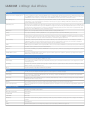
IEEE 802.11n Features
MIMO
MIMO technology is a technique which uses multiple transmitters to deliver multiple data streams via different spatial channels. Depending on the
existing RF conditions the throughput is multiplied with MIMO technology.
40 MHz Channels
Two adjacent 20 MHz channels are combined to create a single 40 MHz channel. Depending on the existing RF Conditions channel bonding doubles
the throughput.
20/40MHz Coexistence Mechanisms in the
2.4GHz Band
Support of coexisting accesspoints with 20 and 40MHz channels in 2.4GHz band.
MAC Aggregation and Block
Acknowledgement
MAC Aggregation increase the IEEE 802.11 MAC efficiency by combining MAC data frames and sending it out with a single header. The receiver
acknowledges the combined MAC frame with a Block Acknowledgement. Depending on existing RF conditions, this technique improves throughput
by up to 20%.
Space Time Block Coding (STBC)
Coding method according to IEEE 802.11n. The Space Time Block Coding improves reception by coding the data stream in blocks.
Low Density Parity Check (LDPC)
Low Density Parity Check (LDPC) is an error correcting method. IEEE 802.11n uses convolution coding (CC) as standard error correcting method,
the usage of the more effective Low Density Parity Check (LDPC) is optional.
Maximal Ratio Combining (MRC)
Maximal Ratio Combining (MRC) enables the receiver (access point), in combination with multiple antennas, to optimally combine MIMO signals
to improve the client reception at long-range.
Short Guard Interval
The guard interval is the time between OFDM symbols in the air. IEEE 802.11n gives the option for a shorter 400 nsec guard interval compared to
the legacy 800 nsec guard interval. Under ideal RF conditions this increases the throughput by upto 10%
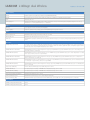
WLAN operating modes
WLAN access point
Infrastructure mode (autonomous operation or managed by LANCOM WLAN controller)