1
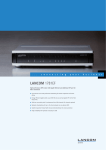
LANCOM 1781A
Features as of: LCOS 9.00
VPN
Number of VPN tunnels
Max. number of concurrent active IPSec, PPTP (MPPE) and L2TPv2 tunnels: 5 (25 with VPN 25 Option). Unlimited configurable connections.
Configuration of all remote sites via one configuration entry when using the RAS user template or Proadaptive VPN.
Hardware accelerator
Integrated hardware accelerator for 3DES/AES encryption and decryption
Realtime clock
Integrated, buffered realtime clock to save the date and time during power failure. Assures timely validation of certificates in any case
Random number generator
Generates real random numbers in hardware, e. g. for improved key generation for certificates immediately after switching-on
1-Click-VPN Client assistant
One click function in LANconfig to create VPN client connections, incl. automatic profile creation for the LANCOM Advanced VPN Client
1-Click-VPN Site-to-Site
Creation of VPN connections between LANCOM routers via drag and drop in LANconfig
IKE
IPSec key exchange with Preshared Key or certificate
Certificates
X.509 digital multi-level certificate support, compatible with Microsoft Server / Enterprise Server and OpenSSL, upload of PKCS#12 files via HTTPS
interface and LANconfig. Simultaneous support of multiple certification authorities with the management of up to nine parallel certificate hierarchies
as containers (VPN-1 to VPN-9). Simplified addressing of individual certificates by the hierarchy's container name (VPN-1 to VPN-9). Wildcards for
certificate checks of parts of the identity in the subject. Secure Key Storage protects a private key (PKCS#12) from theft
Certificate rollout
Automatic creation, rollout and renewal of certificates via SCEP (Simple Certificate Enrollment Protocol) per certificate hierarchy
Certificate revocation lists (CRL)
CRL retrieval via HTTP per certificate hierarchy
OCSP Client
Check X.509 certifications by using OCSP (Online Certificate Status Protocol) in real time as an alternative to CRLs
XAUTH
XAUTH client for registering LANCOM routers and access points at XAUTH servers incl. IKE-config mode. XAUTH server enables clients to register
via XAUTH at LANCOM routers. Connection of the XAUTH server to RADIUS servers provides the central authentication of VPN-access with user
name and password. Authentication of VPN-client access via XAUTH and RADIUS connection additionally by OTP token
RAS user template
Configuration of all VPN client connections in IKE ConfigMode via a single configuration entry
Proadaptive VPN
Automated configuration and dynamic creation of all necessary VPN and routing entries based on a default entry for site-to-site connections.
Propagation of dynamically learned routes via RIPv2 if required
Algorithms
3DES (168 bit), AES (128, 192 or 256 bit), Blowfish (128 bit), RSA (1024-4096 bit) and CAST (128 bit). OpenSSL implementation with FIPS-140
certified algorithms. MD-5, SHA-1, SHA-256, SHA-384 or SHA-512 hashes
NAT-Traversal
NAT-Traversal (NAT-T) support for VPN over routes without VPN passthrough
IPCOMP
VPN data compression based on Deflate compression for higher IPSec throughput on low-bandwidth connections (must be supported by remote
endpoint)
LANCOM Dynamic VPN*
Enables VPN connections from or to dynamic IP addresses. The IP address is communicated via ISDN B- or D-channel or with the ICMP or UDP
protocol in encrypted form. Dynamic dial-in for remote sites via connection template
Dynamic DNS
Enables the registration of IP addresses with a Dynamic DNS provider in the case that fixed IP addresses are not used for the VPN connection
Specific DNS forwarding
DNS forwarding according to DNS domain, e.g. internal names are translated by proprietary DNS servers in the VPN. External names are translated
by Internet DNS servers
IPv4 VPN over IPv6 WAN
Enables the use of IPv4 VPN over IPv6 WAN connections
Content Filter (optional)
Demo version
Activate the 30-day trial version after free registration under http://www.lancom.eu/routeroptions
URL filter database/rating server*
Worldwide, redundant rating servers from IBM Security Solutions for querying URL classifications. Database with over 100 million entries covering
about 10 billion web pages. Web crawlers automatically search and classify web sites to provide nearly 150,000 updates per day: They use text
classification by optical character recognition, key word searches, classification by word frequency and combinations, web-site comparison of text,
images and page elements, object recognition of special characters, symbols, trademarks and prohibited images, recognition of pornography and
nudity by analyzing the concentration of skin tones in images, by structure and link analysis, by malware detection in binary files and installation
packages
URL check*
Database based online check of web sites (HTTP/HTTPS). HTTPS websites are checked based on DNS names of HTTPS server certificates or based
on “Reverse DNS lookup“ of IP addresses.
Categories/category profiles*
Filter rules can be defined in each profile by collecting category profiles from 58 categories, for example to restrict Internet access to business
purposes only (limiting private use) or by providing protection from content that is harmful to minors or hazardous content (e.g. malware sites).
Clearly structured selection due to the grouping of similar categories. Content for each category can be allowed, blocked, or released by override
Override**
Each category can be given an optional manual override that allows the user to access blocked content on a case-by-case basis. The override
operates for a limited time period by allowing the category or domain, or a combination of both. Optional notification of the administrator in case
of overrides
Black-/whitelist
Lists that are manually configured to explicitly allow (whitelist) or block (blacklist) web sites for each profile, independent of the rating server.
Wildcards can be used when defining groups of pages or for filtering sub pages