1
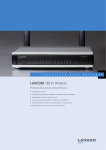
LANCOM L-321agn Wireless
Features as of: LCOS 8.82 ( > REL. D)
Firewall
Tagging
The firewall marks packets with routing tags, e.g. for policy-based routing; Source routing tags for the creation of independent firewall rules for
different ARF contexts
Actions
Forward, drop, reject, block sender address, close destination port, disconnect
Notification
Via e-mail, SYSLOG or SNMP trap
Quality of Service
Traffic shaping
Dynamic bandwidth management with IP traffic shaping
Bandwidth reservation
Dynamic reservation of minimum and maximum bandwidths, totally or connection based, separate settings for send and receive directions. Setting
relative bandwidth limits for QoS in percent
DiffServ/TOS
Priority queuing of packets based on DiffServ/TOS fields
Packet-size control
Automatic packet-size control by fragmentation or Path Maximum Transmission Unit (PMTU) adjustment
Layer 2/Layer 3 tagging
Automatic or fixed translation of layer-2 priority information (IEEE 802.11p-marked Ethernet frames) to layer-3 DiffServ attributes in routing mode.
Translation from layer 3 to layer 2 with automatic recognition of 802.11p-support in the destination device
Security
Intrusion Prevention
Monitoring and blocking of login attempts and port scans
IP spoofing
Source IP address check on all interfaces: only IP addresses belonging to the defined IP networks are allowed
Access control lists
Filtering of IP or MAC addresses and preset protocols for configuration access
Denial of Service protection
Protection from fragmentation errors and SYN flooding
General
Detailed settings for handling reassembly, PING, stealth mode and AUTH port
URL blocker
Filtering of unwanted URLs based on DNS hitlists and wildcard filters
Password protection
Password-protected configuration access can be set for each interface
Alerts
Alerts via e-mail, SNMP-Traps and SYSLOG
Authentication mechanisms
EAP-TLS, EAP-TTLS, PEAP, MS-CHAP, MS-CHAPv2 as EAP authentication mechanisms, PAP, CHAP, MS-CHAP and MS-CHAPv2 as PPP authentication
mechanisms
WLAN protocol filters
Limitation of the allowed transfer protocols, source and target addresses on the WLAN interface
Adjustable reset button
Adjustable reset button for 'ignore', 'boot-only' and 'reset-or-boot'
IP redirect
Fixed redirection of any packet received over the WLAN interface to a dedicated target address
High availability / redundancy
VRRP
VRRP (Virtual Router Redundancy Protocol) for backup in case of failure of a device or remote station. Enables passive standby groups or reciprocal
backup between multiple active devices including load balancing and user definable backup priorities
FirmSafe
For completely safe software upgrades thanks to two stored firmware versions, incl. test mode for firmware updates
Analog/GSM modem backup
Optional operation of an analog or GSM modem at the serial interface
Line monitoring
Line monitoring with LCP echo monitoring, up to 4 addresses for end-to-end monitoring with ICMP polling
Routing functions
Router
IP and NetBIOS/IP multi-protocol router
Advanced Routing and Forwarding
Separate processing of 16 contexts due to virtualization of the routers. Mapping to VLANs and complete independent management and configuration
of IP networks in the device, i.e. individual settings for DHCP, DNS, Firewalling, QoS, VLAN, Routing etc. Automatic learning of routing tags for
ARF contexts from the routing table
HTTP
HTTP and HTTPS server for configuration by web interface
DNS
DNS client, DNS server, DNS relay, DNS proxy and dynamic DNS client
DHCP
DHCP client, DHCP relay and DHCP server with autodetection. Cluster of several LANCOM DHCP servers per context (ARF network) enables caching
of all DNS assignments at each router. DHCP forwarding to multiple (redundant) DHCP servers
NetBIOS
NetBIOS/IP proxy
NTP
NTP client and SNTP server, automatic adjustment for daylight-saving time
Policy-based routing
Policy-based routing based on routing tags. Based on firewall rules, certain data types are marked for specific routing, e.g. to particular remote
sites or lines