1
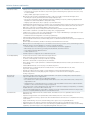
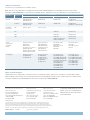
M Series Features and Benefits
Features
Benefits
New service models
• Industry’s most comprehensive VPN portfolio meets the largest number of customer needs and maximizes revenues
–– Simultaneously run Layer 2 Virtual Circuit, Layer 2 VPN, Layer 2.5 Interworking VPNs, Layer 3 2547 VPN, VPLS, IPsec,
IP over IP, and GRE
–– Highly scalable, supporting thousands of VPNs
• Granular QoS with low latency and jitter performance to support voice, video, and other real-time applications
–– Per DLCI, per VP, per VC, per VLAN, per channel (DS0), and per port QoS
–– Classification, rate limiting, shaping, weighted round-robin scheduling, strict priority scheduling, weighted random
early detection, random early detection, and packet marking
–– Mapping Layer 2 (802.1p, CLP, DE) to Layer 3 QoS (IP DSCP, MPLS EXP)
• Hardware-based IPv6 performance, IPv6 over MPLS, IPv6 over IPv4 GRE tunnels, and IPv6/IPv4 dual stack functionality
• Robust multicast support, including IGMP v1/v2/v3, PIM-SM, PIM-DM, MLD, SSM, RP, MSDP, BSR, multicast in MPLS/
BGP VPNs to support resource-efficient delivery of high-value content
• Network-based security services including NAT and stateful firewall, and NAT and stateful firewall per VRF
• MLPPP, MLFR .15 and MLFR .16, and 802.3ad (including LACP) for aggregated links
• Juniper Flow accounting, source class usage, and destination class usage for flexible billing on a per-application or perCoS resource usage basis and for distance-based billing
–– Multivendor network management solution through partnerships
• Industry-leading, XML-based Junoscript API facilitates third-party and in-house OSS development
• Session Border Controller services, for efficient deployment of scalable multimedia services resulting in both CapEx and
OpEx benefits
• Dynamic Application Awareness, enables more visibility to better derive value from traffic
Services everywhere
• One feature-rich Junos OS image runs across all M Series routers, ensuring consistent services and enabling providers to
market all services to all users regardless of connection or serving area density
–– From the smallest PoPs to the largest PoPs, from the enterprise core to branch aggregation
–– Over virtually any access technology including ATM, FR, Ethernet, and TDM connections
–– At any speed, from DS0 to OC-192/STM-64
–– Lowers operational costs
• Seamless migration to larger platforms to meet network growth
Proven dependability
• Production-proven services scaled in the world’s largest networks
• Hitless switchover for RE switchover with non-stop forwarding
• In-service software upgrades for disruption-free minor upgrades
• MPLS FRR to ensure traffic can quickly reroute around failures
• M
PLS TE path control for path optimization combined with predictable performance for latency-sensitive traffic such as
voice and video
• Advanced OA&M features such as LSP ping for troubleshooting MPLS
• IETF Graceful Protocol Restart mechanism for hitless restarts of IS-IS, BGP, OSPF, OSPFv3, LDP, RSVP,
Layer 2 VPN, and Layer 3 VPN
• Modular Junos OS ensures that a failure of one module does not impact the entire operating system
• U
ser-friendly commands for safely deploying new configurations to live networks and for rolling back to previous
working configurations
More from less
infrastructure
• Service-built architecture provides clean separation between control plane, forwarding plane, and services plane to
support multiple services on a single platform
–– Maximum revenue with the lowest possible CapEx and OpEx
–– Consolidate functions previously performed by discrete devices such as NAT, stateful firewall, IPsec, and QoS into a
single M Series router
–– Multiple services on a single platform allows customers to trial many different services without capital investment,
and then to scale successful services to large user populations
• Robust Layer 2 VPNs, Layer 2.5 Interworking VPNs, and Layer 2 to Layer 3 QoS mapping for transparently, consolidating
multiple networks to a common IP/MPLS infrastructure
• Logical routers enable enterprises and providers to segment a router into multiple administrative and routing domains,
so that two completely different organizations can share infrastructure
Secure networks
• High-performance Juniper Protect NAT, stateful firewall, attack detection, DPI/ IPS capabilities and IPsec via the
Multiservices PIC
• Separate routing plane and control plane enables stateful firewall protection of the control plane
• Juniper Flow stateful monitoring of packet flows with standard flowed v5 and v8 records for comprehensive monitoring
of the network
• Highly scalable filtering, unicast RPF, and rate limiting protects against IP spoofing and DOS attacks
• High-performance IPsec and IPsec over MPLS with digital certificate support for an additional layer of security
• Additional ubiquitous security features such as port mirroring, encrypted management session traffic, secure tunneling
capabilities, secure remote logins, and configurable privilege levels and user accounts
3