1
EN
Water-resistant Vehicle with Waterproof Electronics
Your new Horizon Hobby vehicle has been designed and built with
a combination of waterproof and water-resistant components to
allow you to operate the product in many “wet conditions”, including
puddles, creeks, wet grass, snow and even rain.
While the entire vehicle is highly water-resistant, it is not completely
waterproof and your vehicle should NOT be treated like a submarine. The various electronic components used in the vehicle, such as the
Electronic Speed Control (ESC), servo(s) and receiver are waterproof,
however, most of the mechanical components are water-resistant
and should not be submerged.
Metal parts, including the bearings, hinge pins, screws and nuts, as
well as the contacts in the electrical cables, will be susceptible to
corrosion if additional maintenance is not performed after running in
wet conditions. To maximize the long-term performance of your vehicle and to keep the warranty intact, the procedures described in the
“Wet Conditions Maintenance” section below must be performed
regularly if you choose to run in wet conditions. If you are not willing
to perform the additional care and maintenance required, then you
should not operate the vehicle in those conditions.
CAUTION: Failure to exercise caution while using this
product and complying with the following precautions
could result in product malfunction and/or void the warranty.
General Precautions
• Read through the wet conditions maintenance procedures
and make sure that you have all the tools you will need to
properly maintain your vehicle.
• Not all batteries can be used in wet conditions. Consult the
battery manufacturer before use. Caution should be taken
when using Li-Po batteries in wet conditions.
• Most transmitters are not water-resistant. Consult your
transmitter’s manual or the manufacturer before operation.
• Never operate your transmitter or vehicle where lightning may
be present.
• Do not operate your vehicle where it could come in contact
with salt water (ocean water or water on salt-covered roads),
contaminated or polluted water. Salt water is very conductive
and highly corrosive, so use caution.
• Even minimal water contact can reduce the life of your motor
if it has not been certified as water-resistant or waterproof. If
the motor becomes excessively wet, apply very light throttle
until the water is mostly removed from the motor. Running a
wet motor at high speeds may rapidly damage the motor.
• Driving in wet conditions can reduce the life of the motor. The
additional resistance of operating in water causes excess
strain. Alter the gear ratio by using a smaller pinion or larger
spur gear. This will increase torque (and motor life) when
running in mud, deeper puddles, or any wet conditions that will
increase the load on the motor for an extended period of time.
Wet Conditions Maintenance
• Drain any water that has collected in the tires by spinning
them at high speed. With the body removed, place the vehicle
upside down and pull full throttle for a few short bursts until
the water has been removed.
CAUTION: Always keep hands, fingers, tools and any
loose or hanging objects away from rotating parts when
performing the above drying technique.
• Remove the battery pack(s) and dry the contacts. If you have an
air compressor or a can of compressed air, blow out any water
that may be inside the recessed connector housing.
• Remove the tires/wheels from the vehicle and gently rinse the
mud and dirt off with a garden hose. Avoid rinsing the bearings
and transmission.
NOTICE: Never use a pressure washer to clean your vehicle.
• Use an air compressor or a can of compressed air to dry the
vehicle and help remove any water that may have gotten into
small crevices or corners.
• Spray the bearings, drive train, fasteners and other metal
parts with a water-displacing light oil or lubricant. Do not
spray the motor.
• Let the vehicle air dry before you store it. Water (and oil)
may continue to drip for a few hours.
• Increase the frequency of disassembly, inspection and
lubrication of the following:
• Front and rear axle hub assembly bearings.
• All transmission cases, gears and differentials.
• Motor—clean with an aerosol motor cleaner and re-oil
the bushings with lightweight motor oil.
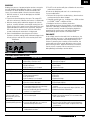
Specifications
Transmitter
Frequency2.4GHz
Modulation
DSM, DSM2, DSMR, Marine
Battery
AA x 4
Servo
Power Supply
Output Torque
Operating Speed
Size
4.8V~6V (shared with receiver)
41.66 oz (3 kg-cm)
0.23sec/60 degrees of travel
55.6 x 18 x 30mm
Electronic Speed Control (ESC)
Input Voltage
Electric Capacity (FET)
Electric Capacity (FET)
PWM Frequency
BEC Voltage
Size
Weight
6.0–8.4 V
Forward 40A/180A
Reverse 20A/90A
1kHz
5V/2A
36 x 31.7 x 18mm
65 g
torment™
3