1
English
Introduction
Congratulations on your purchase and welcome to Philips! To fully
benefit from the support that Philips offers, register your product
at www.philips.com/welcome.
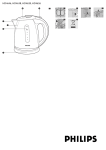
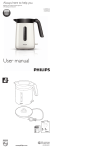
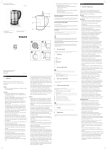
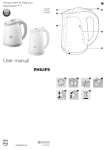
General description  (Fig. 1)
1On/Off switch (I/O)
2Power-on light, Bell (HD4699 and HD4681 only)
3Lid
4Spout
5Water-level indicator
6Base
7Double-Action scale filter
-- In order to avoid a hazard due to inadvertent resetting of the thermal
cut-out, this appliance must not be supplied through an external
switching device, such as a timer, or connected to a circuit that is
regularly switched on and off by the utility.
Boil-dry protection
This kettle is equipped with boil-dry protection. This device automatically
switches off the kettle if it is accidentally switched on when there is no
water or not enough water in it. The on/off switch  stays in ‘on’ position and
the power-on light, if available, stays on. Set the on/off switch to ‘off ’ and let
the kettle cool down for 10 minutes. Then lift the kettle from its base to
reset the boil-dry protection. The kettle is now ready for use again.
Electromagnetic fields (EMF)
This Philips appliance complies with all standards regarding electromagnetic
fields (EMF). If handled properly and according to the instructions in this user
manual, the appliance is safe to use based on scientific evidence available today.
Before first use
1Remove stickers, if any, from the base or the kettle.
Important
Read this user manual carefully before you use the appliance and save it for
future reference.
2Place the base on a dry, stable and flat surface.
Danger
-- Do not immerse the appliance or the base in water or any other liquid.
4Rinse the kettle with water.
-----
---------
------
-1
2
3
4
Warning
Check if the voltage indicated on the base of the kettle corresponds to
the local mains voltage before you connect the appliance.
Do not use the appliance if the plug, the mains cord, the base or the
appliance itself is damaged.
If the mains cord is damaged, you must have it replaced by Philips, a
service centre authorised by Philips or similarly qualified persons in
order to avoid a hazard.
This appliance is not intended for use by persons (including children) with
reduced physical, sensory or mental capabilities, or lack of experience
and knowledge, unless they have been given supervision or instruction
concerning use of the appliance by a person responsible for their safety.
Keep the appliance and its cord out of the reach of children.
Keep the mains cord out of the reach of children. Do not let the mains
cord hang over the edge of the table or worktop on which the appliance
stands. Excess cord can be stored in or around the base of the appliance.
Only use the kettle in combination with its original base.
Keep the mains cord, the base and the kettle away from hot surfaces.
Do not place the appliance on an enclosed surface (e.g. a serving tray),
as this could cause water to accumulate under the appliance, resulting in
a hazardous situation.
Hot water can cause serious burns. Be careful when the kettle contains
hot water.
Never fill the kettle beyond the maximum level indication. If the kettle
has been overfilled, boiling water may be ejected from the spout and
cause scalding.
Do not open the lid while the water is boiling. Be careful when you
open the lid immediately after the water has boiled: the steam that
comes out of the kettle is very hot.
Caution
Always place the base and the kettle on a dry, flat and stable surface.
The kettle is only intended for boiling water. Do not use it to heat up
soup or other liquids or jarred, bottled or tinned food.
Do not touch the body of the kettle during and some time after use, as
it gets very hot. Always lift the kettle by its handle.
Always make sure the water in the kettle at least covers the bottom of
the kettle to prevent the kettle from boiling dry.
Depending on the hardness of the water in your area, small spots may
appear on the heating element of your kettle when you use it. This
phenomenon is the result of scale build-up on the heating element and
on the inside of the kettle over time. The harder the water, the faster
scale builds up. Scale can occur in different colours. Although scale is
harmless, too much scale can influence the performance of your kettle.
Descale your kettle regularly by following the instructions given in
chapter ‘Descaling’.
This appliance is intended to be used in household and similar
applications such as:
staff kitchen areas in shops, offices and other working environments;
farm houses;
by clients in hotels, motels and other residential type environments;
bed and breakfast type environments.
3To adjust the length of the cord, wind it round the reel in the base.
Pass the cord through one of the slots in the base  (Fig. 2)
5Fill the kettle with water up to the MAX level and let the water
boil once (see chapter ‘Using the appliance’).
6Pour out the hot water and rinse the kettle once more.
Using the appliance
1Fill the kettle with water, either through the spout or through the
open lid (Fig. 3).
2If the lid is open, close it.
Make sure that the lid is properly closed to prevent the kettle from boiling dry.
3Place the kettle on its base and put the plug in the wall socket.
4Set the on/off switch to ‘I’ to switch on the kettle (Fig. 4).
Note:You can switch off the kettle at any time by setting the on/off switch to ‘O’.
,, The kettle starts to heat up.
,, The kettle switches off automatically when the water reaches boiling
point.
Cleaning and descaling
Unplug the appliance before you clean it.
Never use scouring pads, abrasive cleaning agents or aggressive liquids
such as petrol or acetone to clean the appliance.
Never immerse the kettle or its base in water.
Cleaning the kettle
1Clean the outside of the kettle with a soft, damp cloth moistened
with warm water and some mild cleaning agent.
Cleaning the filter
Scale is not harmful to your health but it may give your drink a powdery
taste. The scale filter prevents scale particles from ending up in your drink.
Clean the scale filter regularly.
1You can clean the filter in three ways:
1 leave the filter in the kettle when you descale the whole appliance (see
section ‘Descaling the kettle’ in this chapter).
2 remove the filter from the kettle and gently clean it with a soft nylon
brush under the tap (Fig. 5).
3 remove the filter from the kettle and clean it in the dishwasher.
-- To remove the filter, push the filter backwards (1) and then lift it out of
the kettle (2).   (Fig. 6)
2Put the filter back into the kettle after cleaning it under the tap or in
the dishwasher. Slide the filter behind the brackets (1) and then push
it forwards until it snaps home (2) (Fig. 7).
Descaling the kettle
Regular descaling prolongs the life of the kettle.
In case of normal use (up to 5 times a day), the following descaling
frequency is recommended:
-- Once every 3 months for soft water areas (up to 18dH).
-- Once every month for hard water areas (over 18dH).
1Fill the kettle with water up to three-quarters of the MAX level and
bring the water to the boil.