1
English
Connecting to loudspeakers
Wiring strategies
There are three different wiring strategies that can be employed to connect your P1000 to your
speakers. Your choice will be limited by what your speakers can support.
<
Single wiring
Single wiring is the conventional wiring system of running a single cable per channel
between the amplifier and the speaker.
<
Bi-wiring
Bi-wiring is running two separate cables between the amplifier and each speaker, with
one cable carrying the low-frequency information, the other the higher-frequency signals.
Any amplifier can support bi-wiring, but speakers support it only if separate connection
terminals are provided for the two cables (the speaker will have two pairs of terminals
on the back, one pair labelled HF or High Frequency, the other pair labelled LF or Low
Frequency). Bi-wiring improves the sound of your system because the separation of high
and low frequency signal currents into separate speaker cables avoids distortions caused
by the different currents interacting with one-another within a single cable, as occurs in
conventionally wired systems.
Note that some speakers have three pairs of terminals on the back, extending the biwiring principle to tri-wiring.
<
Bi-amping
The performance of your system can be enhanced further by extending the signal-separation
principle to include separate amplification for the low- and high-frequency drivers in each speaker.
You will require two amplifiers to do this.
Before you start!
Ensure that your
P1000 is switched
off and disconnected
from the mains supply
before attempting to
connect speakers.
Failure to do this may
result in both speaker
and amplifier damage.
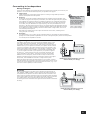
Single wiring
The speaker terminals for any given channel are labelled clearly on the
rear of the P1000. For each channel, connect the positive terminal of
the speaker connection on the P1000 for that channel (coloured red and
labelled with ‘+’) to the positive terminal of your speaker for the channel
(connect, for example, the positive terminal of the centre channel of the
P1000 to the positive channel of your centre speaker). Similarly, connect
the negative terminal of the amplifier (coloured black and labelled with
‘–’) to the negative terminal of your speaker. If your speaker supports
bi-wiring (i.e., it has more than one set of connecting terminals), but
you do not wish to use bi-wiring, connect the P1000 to the terminals
labelled LF or Low Frequency. There should be a strip of metal on the
speakers connecting the low-frequency terminals to those for the higherfrequencies; this must not be removed in a single-wired system.
Follow the above instructions for each speaker in your system, ensuring
that the speakers are connected to the correct output of the P1000. You do
not have to connect speakers to all the channels of the P1000 (e.g., if you
don’t have a centre speaker, it doesn’t matter).
�����������
�� ���
�� ���
�� ���
�� ���
P1000 single wiring illustration (just one
channel shown, for clarity).
Bi-wiring
Bi-wiring is performed in the same way as single wiring except that, for
each speaker, a pair of cables is used to connect the positive terminal of
the amplifier to the speaker. One of the cables must be connected to the
lower of the two positive terminals on Alto, with the other cable connected
to the higher positive terminal. The negative terminals must be connected
in a similar manner. The connecting strip of metal on the speakers
connecting the lower terminals to the upper terminals must be removed for
bi-wiring.
�����������
�� ���
�� ���
�� ���
�� ���
P1000 bi-wiring illustration (just one
channel shown, for clarity).
P1000
E-7