1
X7DA3+ User's Manual
1-3
Special Features
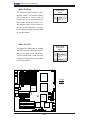
Recovery from AC Power Loss
BIOS provides a setting for you to determine how the system will respond when
AC power is lost and then restored to the system. You can choose for the system
to remain powered off (in which case you must hit the power switch to turn it back
on) or for it to automatically return to a power- on state. See the Power Lost Control
setting in the Advanced BIOS Setup section (Boot Features) to change this setting.
The default setting is Last State.
1-4
PC Health Monitoring
This section describes the PC health monitoring features of the X7DA3+. All have
an onboard System Hardware Monitor chip that supports PC health monitoring.
Onboard Voltage Monitoring
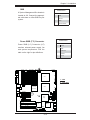
An onboard voltage monitor will scan these voltages continuously: CPU Cores,
Chipset Voltage, +3.3V, +5V, +12V, -12V, +3.3V Standby, +5V Standby and Vbat.
Once a voltage becomes unstable, a warning is given or an error message is sent
to the screen. Users can adjust the voltage thresholds to define the sensitivity of
the voltage monitor.
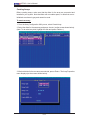
Fan Status Monitor with Firmware Control
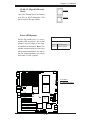
The PC health monitor can check the RPM status of the cooling fans. The onboard
CPU and chassis fans are controlled by Thermal Management via BIOS (under
Hardware Monitoring in the Advanced Setting).
Environmental Temperature Control
The thermal control sensor monitors the CPU temperature in real time and will turn
on the thermal control fan whenever the CPU temperature exceeds a user-defined
threshold. The overheat circuitry runs independently from the CPU. Once it detects
that the CPU temperature is too high, it will automatically turn on the thermal fan
control to prevent any overheat damage to the CPU. The onboard chassis thermal
circuitry can monitor the overall system temperature and alert users when the chassis temperature is too high.
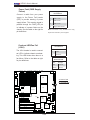
CPU Fan Auto-Off in Sleep Mode
The CPU fan activates when the power is turned on. It continues to operate when
the system enters Standby mode. When in sleep mode, the CPU will not run at full
power, thereby generating less heat.
1-10