1
Network Connectivity
Outdoor wireless LAN solutions
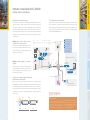
Setting up point-to-point connections
Radar systems to be considered close to your wireless link
LANCOM access points serve not only as central stations in a wireless network, they can also operate in point-
Outdoor point-to-point links are subject to certain legal constraints. It is vital to avoid interference with radar
to-point mode (P2P) to bridge long distances. For example, they can provide a secure connection between two
systems that are active in the 5-GHz spectrum (e.g. meteorological, military). For this reason the European
networks that are several kilometers apart – without direct cabling or expensive leased lines.
regulatory authority ETSI requires WLAN devices operating at 5 GHz to employ the dynamic frequency selection
(DFS) mechanism. This ensures that radar and WLAN systems can co-exist without interfering with one another
and that capacity utilization is spread evenly across available frequencies. The DFS mechanism that ensures a
lawful operation is of course supported by all LANCOM wireless LAN devices.
Wireless LAN
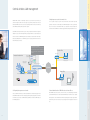
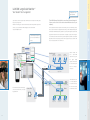
360° omni-directional antenna
Omni-directional antenna attached to
the access point via an extension cable.
Sufficient for shorter ranges.
Sector antenna
The antenna's beam pattern is focused for
transmissions in one direction only. Suitable
for longer ranges.
Directional antenna
For strongly focused antenna transmissions.
With opening angles <10°, these antennas
can bridge ranges of several kilometers.
SA-5L
Surge arrestor between
access point and external
antenna to protect the OAP's
sensitive radio module
Main office
WLAN point-to-point link
SA-LAN
Surge arrestor protects
your devices in the LAN
Rule of thumb:2.4 GHz for short ranges and low interference
5 GHz for links over several kilometers
OAP-321
An access point with
a powerful integrated
5-GHz
directional
antenna often makes
an external antenna
unnecessary.
LANCOM OAP
Branch office
LANCOM switch
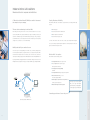
Antenna alignment for P2P operations
When is an external antenna advisable?
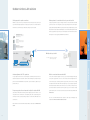
The precise alignment of the antennas is of critical importance for establishing P2P connections. The more
In some scenarios the antennas integrated into an access point, or the rod antenna shipped with it, simply
aligned the receiving antenna is located in the "ideal line" of the transmitting antenna, the better is the actual
do not provide enough performance. One reason can be the distance that must be bridged. Distances of
power and the effective bandwidth. If the receiving antenna is outside of this ideal area, significant losses in
several kilometers require a concentrated signal offered by sector antennas, and for extreme cases a highly
performance will occur.
concentrated directional antenna with a minimal beam angle may be necessary to amplify the signals from
Management
LANCOM router
the radio module. Structural conditions could also favor the use of a sector antenna, for example: If an access
point cannot be installed in a location with a clear line of sight to its peer, it can be connected to a suitably
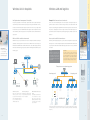
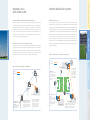
Proper surge protection: an important subject for outdoor WLAN
positioned antenna by means of an extension cable. Find out about the antennas offered by LANCOM under
Outdoor wireless LAN installations should always allow for lightning protection: Even when there are no
www.lancom.eu.
the atmosphere can still occur, leading to damage or destruction of sensitive wireless LAN modules or other
You can also use our LANCOM Antenna Distance Calculator to calculate range and throughput of your
electronic devices.
installation under www.lancom.eu/antenna-distance-calculator.
Services
visible phenomena such as thunderstorms or a direct lightning strike, invisible electrical discharges from
Further information can be found in the LANCOM Outdoor Wireless Solution Guide under www.lancom.eu/
outdoor.
18
19