1
Introduction
Almost any day of the week
you can find Diana Lord
zipping along the paths and
sidewalks of suburban
Washington, DC, riding her
electric scooter. It gets her
around the house, but it also
gets her out of the house. She
goes to church, the grocery
store, the community center,
and the museums and art
galleries in Washington, DC,
via subway, on her scooter.
For users, like Diana, a
scooter isn’t just transportation, it’s independence.
Diana’s in her early 50s, and
has a disabling condition
called neuromyopathy. This
condition weakens both her
nervous and muscle systems
and prevents her from taking
even a few steps. “Last year
it finally hit me,” says Diana.
“If I didn’t do something, I
might never visit an art
gallery again.” That’s when
she started shopping for a
scooter. Diana began by
reading scooter advertisements and writing away for
more information. Next she
test-drove a scooter. “I was
like a teenage boy with his
first motorcycle,” Diana says.
She settled on an indoor/
outdoor scooter for $2,445
and has been a satisfied user
for more than a year. Diana
still drives a car, sporting a
scooter carrier. In reality,
however, it’s the scooter that
gives her the legs she
1
needs to go where she wants
to go.
Diana’s decision to buy a
scooter is like those of more
and more adults. Last year,
approximately 30-40,000
consumers purchased new
scooters. Many scooter
owners, according to an
AARP questionnaire sent to
500 member users, appear to
be older. The average age
was 69 years but there are
also 40 year-olds and 90
year- olds driving scooters.
Half the scooter owners
questioned in the AARP
tabulation purchased their
vehicles within the last two
years and paid an average of
$2,400. Over 60 percent
drive their scooter every day,
and 58 percent use it both
indoors and out. Almost all
users (93 percent) expressed
satisfaction with their vehicles.
Buyers can find plenty of
new and used vehicles to
choose from. There are at
least twenty different manufacturers of scooters, many
with different models. With
all these choices, how do you
make a decision?
Product Report - This booklet provides information to
help you decide if an electric
scooter might meet your
needs. Up to now, very little
comparative information was
widely available. This product report seeks to fill an
information gap with brand-
name information, user comments, and suggestions. We can’t
guarantee you’ll be problem free,
but we’ll help you make a more
informed choice. We wrote this
guide for the first-time buyer.
However, if this is your second
or third purchase, there will be
information you, too, can use.
What’s an
Electric
Scooter?
An electric scooter is a batterypowered, three or four-wheeled
vehicle designed for individuals
who have difficulty walking.
There are scooters for indoor use,
scooters for outdoor use, and
indoor-outdoor scooters for use
in both places.
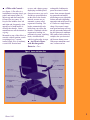
While models vary, each
scooter normally comes
equipped with:
♦ A Metal (or in some in-
stances, plastic) Chassis with
Three or Four Inflatable tires
-The tires could be soft or hard,
filled with air or foam.
♦ An Adjustable Seat with
Armrests – The seat adjusts to
fit the rider and swivels to provide access to tables and desks
while seated on the scooter.
by Lee Norrgard
© Copyright 1995, AARP
AARP Product Report