1
The DVCAM Recorder For A Wide Range Of Applications
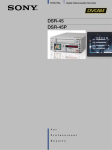
The DSR-25 is a DVCAM Digital Video Recorder specially designed for use in DV-based nonlinear editing suites. In operations
ranging from those in small production houses to corporate institutions and from video journalism to event videography, the DSR-25
is ideal as a source feeder or recorder. It is also an ideal tool for uploading and downloading video to and from i.LINK™1 equipped
and compatible nonlinear editing systems. With its 2-inch2 built-in LCD, using the DSR-25 is easy because important information,
such as the recorded image, audio level, set-up menu, and system status is vividly displayed when you need it. In addition, the
DSR-25 features easy one-touch duplication, the capability to preset user bits and time codes, a built-in tape counter, and a
wireless remote. All of this is offered in one compact and lightweight package.
DVCAM Format For
Excellent Picture And Sound Quality
The DVCAM Format
The DSR-25 uses the DVCAM format, the professional
extension of the worldwide standard DV format. The
DVCAM format uses 8-bit digital component recording
with a 5:1 compression ratio and a sampling rate of
4:1:1 (for 525/60)/4:2:0 (for 625/50). The unique
compression algorithm provides excellent picture quality
and superb multigenerational dubbing performance. It
also offers outstanding digital audio performance by
providing a wide dynamic range and an excellent signalto-noise ratio comparable to CD quality.3 Alternative
audio channel modes can be selected: a two-channel
mode with 48 kHz/16-bit recording or a four-channel
mode with 32 kHz/12-bit recording.
Playback Compatibility with
the DV (25 Mb/s) Format
The DVCAM format maintains playback compatibility with
the consumer DV format4. This compatibility allows the
user to play back DV recorded tapes on the DSR-25.
Such versatility is quite advantageous to users working
with DV cameras for their great portability and long
recording times.
Dual-size Cassette Mechanism
The DSR-25 has a dual-size cassette mechanism that
accepts both mini and standard size DVCAM and DV
cassette tapes without using any special adaptor. This
innovative feature allows the four different types of
cassette tapes to be used without the cumbersome
process associated with additional mechanical hardware.
Long-duration Recording Capability
DVCAM videocassette tapes come in two sizes: standard
and mini. A recording time of up to 184 minutes is
possible with a standard-size cassette (PDV-184ME),
while the mini cassette (PDVM-40ME) allows up to 40
minutes. Although the tape is relatively narrow, 1/4-inch
(6.35 mm), and the cassettes compact, these long
recording times are achieved by using Sony advanced
ME (Metal Evaporated) tape.
Capability of Recording in DV Format5
Should you require a longer record time than what is
available with the DVCAM format, the DSR-25 is capable
of recording in the DV format. In DV format, the DSR-25
offers 270 minutes of recording with the standard-size
cassette.
NTSC/PAL Switchable Operation
To accommodate the growing needs for international
program exchange, the DSR-25 is built with the flexibility
for switchable operation in 525/625 environments.6 This
feature is also ideal for multinational operations that
require dual compatibility. When recording through the
i.LINK interface or in playback mode, the DSR-25
automatically detects the color system of the source. If
you choose to use the analog interface, the manual
select switch on the rear panel allows you to select the
required mode.
1. i.LINK is a Sony trademark used only to designate that a product is equipped with an IEEE 1394 connector. All products with an i.LINK connector may not communicate with each other. Please refer to the documentation that
comes with any device having an i.LINK connector for information on compatibility, operating conditions, and proper connection. 2. Viewable area measured diagonally. 3. At 48 kHz/16-bit. 4. In SP mode only
5. When recording in DV (SP) format, transitions between cut to cut may not be smooth. In addition, when the recording format is switched between DVCAM and DV, the transition may not be recorded smoothly. This is a normal
and expected phenomenon.