1
E-5250
User's Guide
MAN SYS US E5250 USR GDE R0 6/98
8502956
E-5250 User’s
Guide
Part #8502956
MAN SYS US E5250 USR GDE R0
7/98
In our effort to use nature’s resources efficiently and wisely, we print all manuals on recycled papers that meet the
minimum requirements established by the Federal EPA in its guidelines for recycled paper products.
Notices
Copyright © 1998 Gateway 2000, Inc.
All Rights Reserved
610 Gateway Drive
N. Sioux City, SD 57049 USA
All Rights Reserved
This publication is protected by copyright and all rights are reserved. No part of it may be reproduced
or transmitted by any means or in any form, without prior consent in writing from Gateway 2000.
The information in this manual has been carefully checked and is believed to be accurate. However,
changes are made periodically. These changes are incorporated in newer publication editions.
Gateway 2000 may improve and/or change products described in this publication at any time. Due to
continuing system improvements, Gateway 2000 is not responsible for inaccurate information which
may appear in this manual. For the latest product updates, consult the Gateway 2000 web site at
www.gateway.com. In no event will Gateway 2000 be liable for direct, indirect, special, exemplary,
incidental, or consequential damages resulting from any defect or omission in this manual, even if
advised of the possibility of such damages.
In the interest of continued product development, Gateway 2000 reserves the right to make
improvements in this manual and the products it describes at any time, without notices or obligation.
Trademark Acknowledgments
AnyKey, black-and-white spot design, ColorBook, CrystalScan, Destination, EZ Pad, EZ Point, Field
Mouse, Gateway 2000, HandBook, Liberty, TelePath, Vivitron, stylized “G” design, and “You’ve got a
friend in the business” slogan are registered trademarks and “All the big trends start in South Dakota”
slogan, GATEWAY, and Gateway Solo, are trademarks of Gateway 2000, Inc. Intel, Intel Inside logo,
Pentium, and LANDesk are registered trademarks and Xeon is a trademark of Intel Corporation.
Microsoft, MS, MS-DOS, Windows, and Windows NT are trademarks or registered trademarks of
Microsoft Corporation. All other product names mentioned herein are used for identification purposes
only, and may be the trademarks or registered trademarks of their respective companies.
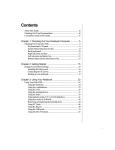
Contents
Preface ..................................................................................... iii
Conventions Used in This Guide........................................................... iv
Safety Instructions................................................................................... v
Getting Started ......................................................................... 1
Setting Up Your System.......................................................................... 2
Starting Your System .............................................................................. 3
Understanding the Power-On Self-Test .......................................... 5
Setting Up the Operating System .................................................... 5
Installing and Restoring LANDesk ................................................. 6
Turning Off Your System ....................................................................... 7
Resetting Your System............................................................................ 8
System Features ..................................................................... 9
Computer Features ................................................................................ 10
AGP Video ..................................................................................... 10
BIOS ............................................................................................... 10
Cache Memory............................................................................... 10
Connectors...................................................................................... 10
Drives.............................................................................................. 11
Expansion Slots .............................................................................. 12
Intel 440GX Chip Set..................................................................... 12
Manageability................................................................................. 12
Memory .......................................................................................... 12
Networking..................................................................................... 13
Processor......................................................................................... 13
Front Panel............................................................................................. 14
Rear Panel.............................................................................................. 16
Contents
i
Maintaining and Cleaning Your System ................................19
Maintaining the Hard Drive..................................................................
Protecting Against Viruses...................................................................
Cleaning Your System..........................................................................
Cleaning the Mouse.......................................................................
Cleaning the Keyboard ..................................................................
Cleaning the Monitor Screen.........................................................
Cleaning the Computer and Monitor Cases..................................
20
21
22
22
22
23
23
Appendix .................................................................................25
Acronyms and Abbreviations............................................................... 26
Terms and Definitions .......................................................................... 28
Regulatory Compliance Statements..................................................... 31
Index....................................................................................... 35
ii
E-5250 User’s Guide
Preface
Contents
Conventions Used in This Guide ........................... iv
Safety Instructions................................................... v
Conventions Used in This Guide
Throughout this guide, you will see the following conventions:
iv
E-5250 User’s Guide
Convention
Description
ENTER
Keyboard key names are printed in small
capitals.
CTRL+ALT+DEL
A plus sign indicates that the keys must be
pressed simultaneously.
Setup
Commands to be entered, options to
select, and messages that appear on your
monitor are printed in bold.
User’s Guide
Names of publications and files are printed
in italic.
Important!
An important informs you of special
circumstances.
Caution!
A caution warns you of possible damage
to equipment or loss of data.
Warning!
A warning indicates the possibility of
personal injury.
Safety Instructions
Observe the following safety instructions when using your system:
•
Follow all instructions marked on the system and in the
documentation.
•
When the system is turned off, a small amount of electrical current
still runs through the system. Always unplug the system from the
electrical outlet before cleaning the system or opening the cover.
(Follow the cleaning instructions on page 22.)
•
Do not use this product near water or a heat source, such as a
radiator or heat register.
•
Do not spill anything on or into the system. The best way to avoid
spills is to avoid eating and drinking near your system.
•
•
Make sure you set up the system on a stable work surface.
•
Use the voltage setting for your area. The voltage selector switch is
set at the factory to the correct voltage.
•
This system is equipped with a 3-wire grounding plug (a plug with
a grounding pin). This plug will only fit into a grounded power
outlet. This is a safety feature. Do not defeat the purpose of the
grounding pin. If you are unable to insert the plug into the outlet,
contact your electrician to replace the outlet.
•
•
Do not walk on the power cord or allow anything to rest on it.
Warning!
Do not attempt to service
the system yourself except
as explained elsewhere in
the system documentation.
Adjust only those controls
covered in the instructions.
Opening or removing
covers marked “Do Not
Remove” may expose you
to dangerous electrical
voltages or other risks.
Refer all servicing of those
compartments to qualified
service personnel.
Openings in the system cabinet are provided for ventilation. Do not
block or cover these openings. Make sure you provide adequate
space (at least 12 inches) around the system for ventilation when
you set up your work area. Never insert objects of any kind into the
system ventilation slots.
If you use an extension cord with this system, make sure the total
ampere ratings on the products plugged into the extension cord do
not exceed the extension cord ampere rating. Also, the total ampere
requirements for all products plugged into the wall outlet must not
exceed 15 amperes.
Preface
v
vi
E-5250 User’s Guide
•
There is a danger of explosion if the CMOS (complementary
metal-oxide semiconductor) battery is replaced incorrectly.
Replace the battery with the same or equivalent type recommended
by the manufacturer. Dispose of used batteries according to the
manufacturer’s instructions.
•
Unplug the system from the wall outlet and refer servicing to
qualified personnel if:
•
The power cord or plug is damaged.
•
Liquid has been spilled into the system.
•
The system does not operate properly when the operating
instructions are followed.
•
The system was dropped or the cabinet is damaged.
•
The system’s performance changes.
Getting Started
Contents
Setting Up Your System.......................................... 2
Starting Your System .............................................. 3
Turning Off Your System ....................................... 7
Resetting Your System............................................ 8
Important!
Keep the product carton
and packing material, in
case you need to send the
system out for repair. If you
return your system to the
factory in different
packaging, your warranty
may be void.
Caution!
Make sure your computer
and peripherals are turned
off and unplugged from the
power outlet when you
connect peripherals to the
computer.
2 E-5250 User’s Guide
Setting Up Your System
Before you set up your system, prepare a safe working environment for it.
•
Provide a clean, flat, and stable surface for your system. Allow at
least 12 inches at the rear of the computer for cabling and air
circulation.
•
Obtain a grounded (three-prong) AC surge-protected power strip.
A surge-protected power strip helps protect against AC line spikes.
•
Protect your system from extreme temperature and humidity. Do
not expose your system to direct sunlight, heater ducts, or other
heat-generating objects.
•
Keep your computer away from equipment that generates magnetic
fields, such as unshielded stereo speakers. Even a telephone placed
too close to the computer may cause interference.
•
Plug the computer into a wall outlet or power strip that is easily
accessible. When you turn off the computer with the power button,
some electricity still flows through the computer. To remove all
power from the computer, you need to unplug it.
After you prepare a safe working environment, use the poster that came
with your system to set up the system.
Starting Your System
Before you start your system for the first time:
•
Check that the voltage selector switch on the back of the computer
is still set to the correct voltage for your area. This switch is set at
the factory to the correct voltage. (See the illustration on page 16
for the location of the switch.)
•
Make sure all cables are firmly connected to the proper cable ports
on the rear panel of the computer.
•
Make sure the computer and monitor are plugged into an AC outlet
or power strip.
To start the system
1. If you have connected the system components to a power strip, make
sure all the system components are turned off, and then turn on the
power strip.
2. Press the power button on the monitor to turn on the monitor.
Getting Started
3
3. Press the power button on the computer to turn on the computer. The
power light-emitting diode (LED) on the front panel is lit when the
computer’s power is on.
Reset button
Power button
Power LED
4. Turn on any other components connected to the computer, such as
speakers, a printer, or a scanner.
5. If nothing happens when you turn on the system:
•
Recheck the power cables to see that they are securely plugged in
and that your power strip (if you are using one) is plugged in and
turned on.
•
Make sure the monitor is connected to the computer, plugged into
the power strip or AC outlet, and turned on. You may also need to
adjust the brightness and contrast controls on the monitor.
Wait until the startup procedure is finished before loading a diskette in the
diskette drive, or the computer may search on the diskette for startup
information.
4 E-5250 User’s Guide
For more troubleshooting information, see the “Troubleshooting” chapter in
the Maintaining and Troubleshooting Your E-5250 System guide.
Understanding the Power-On Self-Test
When you turn on your computer, the power-on self-test (POST) routine
checks the system memory and components. To see the POST information
on the screen, press TAB during POST. Press ESC to bypass the remaining
memory count.
The system beeps or displays an error message if POST finds any
problems. Write down the number of beeps that sound or the error message
that appears. See the “Troubleshooting” chapter of the Maintaining and
Troubleshooting Your E-5250 System guide for a description of the beep
codes and error messages.
Setting Up the Operating System
Your computer comes with the Microsoft® Windows NT® 4.0 operating
system. The first time you start your computer, the operating system takes a
few minutes to set up. As you start Windows NT, if you are connecting to a
network, have your transmission control protocol/Internet protocol (TCP/
IP) information available. Contact your system administrator for your TCP/
IP information.
Refer to your software documentation for specific instructions on what to
do after the computer starts.
To complete the operating system setup
1. After the computer starts, the Start-up wizard opens. Click Next to
continue.
2. Type the requested information in the appropriate text boxes. When
you have finished entering the information, click Next.
Getting Started
5
3. Continue following the instructions and selecting options in the Start-
up wizard dialog boxes, clicking Next to move through the dialog boxes
until the wizard tells you to restart your computer.
Most of the dialog boxes that open in the Start-up wizard have a button
that takes you back to previous dialog boxes in case you need to
change or correct the information you typed.
4. Restart your system. The setup is complete.
Installing and Restoring LANDesk
LANDesk® Client Manager is the desktop management interface (DMI)
solution that is already loaded on your system. LANDesk Client Manager
lets you monitor your system for critical situations that may need your
attention. It also lets your system administrator remotely inventory and
manage systems on your network.
1. In the C:\DMI folder, double-click the Setup icon to launch the
InstallShield® wizard.
2. Follow the instructions that appear on your screen. If you are prompted
for a password during the installation process, enter LOWTCO.
LANDesk Client Manager comes with complete electronic documentation
and online help. Refer to these documents and the program’s Help for any
LANDesk concerns.
If you ever need to restore LANDesk from the System Restoration CD that
came with your system, enter LOWTCO if prompted for a password.
6 E-5250 User’s Guide
Turning Off Your System
Every time you turn off your system, shut down the Windows NT operating
system first. You may lose data if you do not follow the proper procedure.
To turn off your system
1. On the Taskbar, click Start.
2. Click Shut Down.
Warning!
When you turn the
computer off by pressing
the power button, some
electric current still flows
through the computer.
Before opening the
computer case or
connecting or removing any
peripherals, turn off the
computer and then unplug
the power cord from the
electrical outlet.
3. Select Shut down the computer?
4. Click OK.
5. When you see a message saying It is now safe to turn off your computer,
press your computer’s power button to turn off the computer. Then
turn off the monitor and peripherals.
Getting Started
7
Resetting Your System
If your computer does not respond to keyboard or mouse input, you may
need to reset the system.
To reset your system
1. Press CTRL+ALT+DEL. A window opens that enables you to close a
program that is not responding.
2. Click Task Manager, select the program that is not responding, and click
End Task.
3. If your computer does not respond, press the reset button on the
computer. (For the location of the reset button, see the figure on
page 4.) The computer turns off and restarts.
A program to check the disk status runs automatically and then
Windows NT starts.
8 E-5250 User’s Guide
System
Features
Contents
Computer Features ................................................ 10
Front Panel............................................................. 14
Rear Panel .............................................................. 16
Computer Features
The following features are standard to the computer’s basic architecture.
AGP Video
An accelerated graphics port (AGP) video connector on the system board
and an AGP expansion card are standard features. AGP is a bus architecture
that increases video performance by routing video signals through a
dedicated graphics bus rather than sending video signals on the PCI bus.
BIOS
The basic input/output system (BIOS) is software that enables your
computer to communicate with peripheral devices (such as the keyboard,
mouse, and monitor) without using programs on the hard drive.
The battery in your computer maintains the BIOS settings in
complementary metal-oxide semiconductor (CMOS) memory even when
the computer is turned off.
You can change the BIOS settings through the Setup program. Open Setup
by pressing F1 when you are prompted as your computer starts.
Cache Memory
Your computer includes level 1 (L1) and level 2 (L2) cache. This cache
memory is located on the processor. Cache reduces the average time
required for the processor to get the data it needs from the main memory by
storing recently accessed data in the cache.
Connectors
The standard input/output (I/O) connectors included with the computer are:
•
•
•
10
E-5250 User’s Guide
Keyboard port
Mouse port
Two serial ports
•
•
•
•
•
•
Parallel port
Two universal serial bus (USB) ports
Audio-out jack
AGP video port
Network connector
External SCSI connector.
Drives
The standard configuration for your computer includes a 1.44-MB 3.5-inch
diskette drive, a hard drive, and a CD-ROM drive. You can install up to
seven additional drives (depending on drive height) in the computer.
Two IDE controllers and a diskette controller are integrated into the system
board. A SCSI controller card is also included as a standard feature. For
instructions on installing drives, see the “Installing Components” chapter in
the Maintaining and Troubleshooting Your E-5250 System guide.
The first 2 gigabytes (GB) of the hard drive shipped with your Windows
NT computer are partitioned as file allocation table (FAT)16. The rest of the
space on the drive is partitioned as NT file system (NTFS). Any other hard
drives shipped from the factory with your computer are partitioned as
NTFS.
FAT16 and NTFS are different methods that the operating system uses to
organize and keep track of files on a hard drive. Your hard drive is divided
into both types of partitions to support your 16-bit software and your 32-bit
software.
FAT16 supports the older 16-bit software and is limited to partitions of 2
GB or less. NTFS supports 32-bit software and large drive sizes. Unlike
FAT16 partitions, NTFS partitions cannot be viewed with Microsoft® disk
operating system (MS-DOS®) diagnostic utilities, such as fdisk. See your
Windows NT manual for more information on NTFS.
System Features
11
Expansion Slots
Expansion slots inside the computer enable you to install add-in cards, such
as a SCSI (small computer system interface) controller. Your computer
includes one AGP slot, six 32-bit peripheral component interconnect (PCI)
slots, and one 8/16-bit industry standard architecture (ISA) slot.
The maximum number of slots that you can fill is seven. The ISA slot and
PCI slot next to each other share a slot location. You can use one or the
other slot, but not both. For instructions on installing add-in cards, see the
“Installing Components” chapter in the Maintaining and Troubleshooting Your
E-5250 System guide.
Intel 440GX Chip Set
The Intel® 440GX chip set provides support for Pentium® II Xeon™
processors. The chip set’s Quad Port Acceleration improves bandwidth
between the processor, the AGP, 100-Mhz SDRAM, and the PCI bus.
Manageability
The status of your system’s hardware is monitored through the hardware
management application specific integrated circuit (ASIC) on the system
board. Monitored information includes voltage and chassis intrusion.
You can access the monitoring information through Intel LANDesk Client
Manager, which provides a quick system health indicator.
Memory
Important!
See the Maintaining and
Troubleshooting Your E5250 System guide for a
complete description of the
type of DIMMs you can
install in your computer.
12
E-5250 User’s Guide
Your computer comes standard with error correcting code (ECC)
synchronous dynamic random access memory (SDRAM). You can install
up to 2 GB of memory in the four memory slots on the system board. You
can fill the slots with DIMMs of the sizes 128 MB, 256 MB, and 512 MB
(when available).
No jumper settings are required for the memory size or type because this
information is automatically detected by the BIOS. For information on
installing additional memory, see the “Installing Components” chapter in
the Maintaining and Troubleshooting Your E-5250 System guide.
Networking
For easy connection to a network, a PCI-based 10/100 megabits per second
(Mbps) networking card is provided as a standard component of your
computer.
Processor
Your computer includes support for dual Intel Pentium II Xeon processors.
The Pentium II Xeon processor is designed to support the needs of singleand multithreaded workstation applications. The processor includes fast
ECC level 2 cache and multiprocessing capabilities.
One processor comes standard in the computer. The other processor slot is
filled with a terminator card. If you add a second processor, both processors
should be of the same clock speed and have the same amount of cache
memory.
A voltage regulator connector on the system board provides support for a
voltage regulator module that is installed if your system includes two
processors.
Installing two processors enables your computer to take advantage of
multithreading on some 32-bit graphics applications. These applications
may run faster with two processors than with one. See your software
documentation for more information.
For information on removing and installing a processor, see the “Installing
Components” chapter in the Maintaining and Troubleshooting Your E-5250
System guide.
System Features
13
Front Panel
The front panel of your computer includes the following features:
CD-ROM
volume control
Audio-out jack
CD-ROM drive
CD-ROM stop/
eject button
CD-ROM play/
fast forward
button (on some
CD-ROM drives)
Diskette drive
Diskette eject
button
Reset button
Power button
Power LED
Hard Drive LED
Audio-out jack: Connects headphones or powered speakers that enable
you to listen to an audio CD.
CD-ROM drive: Plays data or audio CDs.
14
E-5250 User’s Guide
CD-ROM volume control: Controls the volume of an audio CD.
CD-ROM play/fast forward button: Starts the CD or fast forwards
through the CD. Hold the button down for fast forward. (This button may
not appear on your CD-ROM.)
CD-ROM stop/eject button: Stops a CD and ejects it from the CD-ROM
drive.
Diskette drive: Writes to and reads from 3.5-inch, 1.44 MB diskettes.
Diskette eject button: Ejects diskettes from the diskette drive
Hard drive LED: Lights when the hard drive is active.
Power button: Turns the computer on and off.
Power LED: Lights when the computer is turned on.
Reset button: Restarts the computer.
System Features
15
Rear Panel
The rear panel includes the following I/O ports, connectors, and switches:
Voltage selector
Power connector
Keyboard port
Mouse port
USB ports
Serial port 1 (A)
Parallel port
Serial port 2 (B)
Video port
Network jack
External SCSI
connector
External SCSI connector: Connects external SCSI devices.
Keyboard port: Connects a Personal System/2 (PS/2)-compatible
keyboard.
16
E-5250 User’s Guide
Mouse port: Connects a PS/2-compatible mouse.
Power connector: Connects the computer power cord. The other end of the
power cord plugs into an AC outlet or power strip.
Parallel (printer) port: Connects a printer or other parallel device.
Network jack: Connects a cable that connects the computer to a network.
Serial ports: Connect serial devices, such as musical instrument digital
interface (MIDI) devices.
USB ports: Connect external Plug-and-Play devices that are automatically
configured when they are plugged into the computer through one of these
ports. USB devices include keyboards, pointing devices, monitors, and so
on.
Video port: Connects the monitor’s interface cable. The video port
provides AGP capabilities.
Voltage selector: Sets the voltage for your area, either 115 volts (V) or 230
V.
Caution!
Setting your computer to
the wrong voltage can
damage the computer.
System Features
17
18
E-5250 User’s Guide
Maintaining and
Cleaning Your
System
Contents
Maintaining the Hard Drive .................................. 20
Protecting Against Viruses.................................... 21
Cleaning Your System .......................................... 22
Maintaining the Hard Drive
Hard drives need regular maintenance because running the system software
divides files, creates spaces between data, and otherwise decreases hard
drive performance. Windows NT provides the Check Disk utility to
maintain the hard drive. Check Disk enables you to check the drive for
errors, fix file system errors, and attempt to recover bad sectors on the
drive.
Use Check Disk from once a week to once a month, depending on how
often you use your computer. Also use Check Disk whenever you have any
hard drive problems.
To use Check Disk
1. Right-click Start and then click Explore.
2. In the Windows NT Explorer window, right-click the drive you want to
check. You can only check one drive at a time.
3. Click Properties.
4. Click the Tools tab.
5. Click Check Now in the Error-checking dialog box.
6. Check Scan for and attempt recovery of bad sectors to scan the entire hard
drive.
7. Click Start. If the scan finds bad sectors, a screen message will notify
you.
20
E-5250 User’s Guide
Protecting Against Viruses
A virus is a program written with malicious intent for the purpose of
creating havoc in a computer system. It attaches itself to executable files or
boot sectors, so it can replicate and spread. Some viruses may only cause
your system to beep or display messages or images on the screen. Other
viruses are highly destructive and corrupt or erase the contents of your files
or diskettes. To be safe, never assume any virus is harmless.
Viruses spread through direct contact with executable programs or boot
sectors. Diskettes used in a contaminated system can get a virus and
transfer the virus when used in another system. A virus can also spread
through programs downloaded from bulletin boards or the Internet.
To protect your system against viruses
•
Obtain an antivirus program and scan your system regularly.
•
•
Make backup copies of all files and write-protect the diskettes.
Obtain all software from reputable sources and always scan new
software for any viruses before installing files.
If you suspect your system has been infected, find and remove the viruses
immediately using an antivirus program. Next, turn off your system and
leave it off for at least 15 seconds before turning it back on. This is the only
way to ensure the virus does not remain in your system RAM.
Maintaining and Cleaning Your System
21
Cleaning Your System
Warning!
When you clean the
system, turn it off and
unplug the power cord. Be
careful not to drip liquid into
the computer and
peripherals when cleaning
the system.
The following sections contain information about cleaning the parts of your
system.
Cleaning the Mouse
If the mouse pointer on the screen moves erratically when you move the
mouse, the roller ball inside the mouse may be dirty.
To clean the mouse
1. Turn off the system and then disconnect the mouse cable from the
mouse port.
2. Turn your mouse upside down and remove the roller ball cover.
3. Cup your hand under the mouse and turn your mouse right-side up.
The roller ball should drop into your hand. If it does not, gently shake
the mouse until the ball drops out of the socket.
4. Use adhesive tape to pick up any dust or lint on the surface of the ball
and wipe away dirt or lint inside the ball socket. You can also blow into
the socket to remove dirt and lint. If foreign matter is trapped inside
the socket, use a cotton swab dipped in isopropyl alcohol to loosen it.
Let surfaces dry completely after cleaning.
5. Return the ball to the socket and replace the cover.
Cleaning the Keyboard
Occasionally, you should clean the keyboard to free it of dust and lint
particles trapped under the keys. The easiest way to do this is to blow
trapped dirt from under the keys using an aerosol can of air with a narrow,
straw-like extension.
22
E-5250 User’s Guide
If you spill liquid on the keyboard, turn off the computer and disconnect the
keyboard. Turn the keyboard upside down to let the liquid drain out and the
keyboard dry for a few days before trying to use the keyboard again. If the
keyboard does not work after draining, contact Technical Support.
Cleaning the Monitor Screen
Use a soft cloth and window cleaner to clean the monitor screen. Squirt a
little cleaner on the cloth (never directly on the screen), and wipe the screen
with the cloth.
Cleaning the Computer and Monitor Cases
Always turn off the computer and other peripherals before cleaning any
components.
Use a damp lint-free cloth to clean the computer case, monitor case,
keyboard, speakers, and other parts of your system. Avoid abrasive or
solvent cleaners because they can damage the finish on your components.
Maintaining and Cleaning Your System
23
24
E-5250 User’s Guide
Appendix
Contents
Acronyms and Abbreviations ............................... 26
Terms and Definitions........................................... 28
Regulatory Compliance Statements ..................... 31
Acronyms and Abbreviations
ASIC - Application specific integrated circuit
BIOS - Basic input/output system
CMOS - Complementary metal-oxide semiconductor
DIMM - Dual inline memory module
DMI - Desktop management interface
DRAM - Dynamic random access memory
ECC - Error correcting code
FAT - File allocation table
GB - Gigabyte
IDE - Integrated drive electronics
IRQ - Interrupt request line
ISA - Industry standard architecture
LAN - Local area network
LED - Light-emitting diode
MB - Megabyte
Mbps - Megabits per second
MIDI - Musical instrument digital interface
MHz - Megahertz
MS-DOS - Microsoft disk operating system
NTFS - NT file system
POST - Power-on self-test
PS/2 - Personal System/2
RAM - Random-access memory
26
E-5250 User’s Guide
ROM - Read-only memory
SCSI - Small computer system interface
SDRAM - Synchronous dynamic random access memory
TCP/IP - Transmission control protocol/Internet protocol
V - Volt
Appendix A
27
Terms and Definitions
This list of terms should help you get acquainted with terms used in your
computer’s documentation and in your system software.
Applications - Software installed on your system. Sometimes called
programs.
BIOS - Basic input/output system. The BIOS is software that is
independent of any operating system. It enables the computer to
communicate with the monitor, keyboard, and other peripheral devices
without using programs on the hard disk.
The BIOS on your computer is flash BIOS, which means that is has been
recorded on a memory chip that can be updated if needed.
Boot - To load the first software program (usually the operating system)
that starts your computer. To perform a cold (or hard) boot, you turn the
computer on when it is off. To perform a warm (or soft) boot, you reset the
computer when it is already turned on.
Boot disk - A disk containing operating system programs required to start
your computer. A boot disk can be a diskette, hard drive, or CD.
Byte - The basic unit of measure for computer memory. A character, such
as a letter of the alphabet, uses one byte of memory. Each byte is made up
of eight bits. Computer memory is often measured in kilobytes (1,024
bytes) or megabytes (1,048,576 bytes).
Cache memory - Cache is very fast memory that can be located in the
processor. Cache reduces the average time required for the processor to get
the data it needs from the main memory by storing recently accessed data in
the cache.
CMOS memory - Complementary metal oxide semiconductor memory.
CMOS memory is memory that is retained even when the computer is
turned off. The Setup program settings and other parameters are maintained
in CMOS memory.
Default - The option that the software or system uses when you have not
made a choice yourself.
Disc - A compact disc (CD).
28
E-5250 User’s Guide
Disk - The device used by the computer to store and retrieve information.
Disk can refer to a diskette or a hard disk.
Diskette - A removable disk, also called a floppy.
Hard drive - The drive installed inside your computer that stores all your
system and data files. Depending on its configuration, the computer may
have more than one hard drive. Each drive is assigned its own drive letter. If
you have only one drive, its drive letter is C, and it is often called “the C
drive.”
I/O - Input/output. Refers to devices, such as printers, whose purpose is to
enter data into a computer or extract data from a computer. An I/O device is
accessed through an I/O address: a location in memory reserved for the
device to exchange information between itself and the rest of the computer.
IRQ - Interrupt request line. The IRQ is a hardware line that a device uses
to signal the processor when the device needs the processor’s services. The
number of IRQs is limited by industry standards.
Operating system - A program that supervises the computer’s operation,
including handling I/O, networking and connectivity, and device drivers.
Path - A sequence of information that directs the system to the file it needs.
For example, c:\windows\bubbles.bmp is the path to a graphics file on
your system. The c: tells the system it is on the C hard drive, the \windows
tells the system it is in the windows folder, and bubbles.bmp is the file.
Pixel - A pixel is an individual dot in a graphic displayed on your computer.
Pixels are so close together that they look as though they are connected.
POST - Power-on self-test. POST tests your computer’s components
whenever you turn on the computer.
Programs - Software installed on your system. Programs are sometimes
called applications.
RAM - Random access memory. RAM is the computer’s system memory.
You can write to and read from RAM. Information stored in RAM is
temporary and is erased when the computer is turned off.
Appendix A
29
Refresh rate - The refresh rate is the rate at which the image on the monitor
screen is rewritten to the screen. A fast refresh rate helps keep the image
from flickering.
Resolution - The resolution is the sharpness or clarity of the image on the
monitor screen. Resolution is measured by the number of pixels the screen
can display. For example, a resolution of 800x600 means that the screen can
display 800 pixels in a row and can display 600 rows. The more pixels
displayed, the higher the resolution and the clearer the images.
ROM - Read-only memory. Permanent computer memory dedicated to a
particular function. For example, the instructions for starting the computer
when you first turn on power are contained in ROM. You cannot write to
ROM.
30
E-5250 User’s Guide
Regulatory Compliance
Statements
This device has been tested and found to comply with the limits for a Class
B digital device, pursuant to Part 15 of the FCC rules. These limits are
designed to provide reasonable protection against harmful interference in a
residential installation. This equipment generates, uses, and can radiate
radio frequency energy and, if not installed and used in accordance with the
instructions, may cause harmful interference to radio or television
reception. However, there is no guarantee that interference will not occur in
a particular installation. If this equipment does cause interference to radio
and television reception, which can be determined by turning the equipment
off and on, the user is encouraged to try to correct the interference by one or
more of the following measures:
•
Reorient or relocate the receiving antenna.
•
Increase the separation between the equipment and receiver.
•
Connect the equipment into an outlet on a circuit different from
that to which the receiver is connected.
•
Consult the dealer or an experienced radio/TV technician for help.
•
Use shielded I/O cables when operating this equipment.
American Users
Caution!
The Federal
Communications
Commission warns users
that changes or
modifications to the unit not
expressly approved by the
party responsible for
compliance could void the
user’s authority to operate
the equipment.
Accessories: This equipment has been tested and found to comply with the
limits of a Class B digital device. The accessories associated with this
equipment are as follows:
•
Shielded video cable
•
Shielded power cord
These accessories are required to be used in order to ensure compliance
with FCC rules.
This digital apparatus does not exceed the Class B limits for radio noise
emissions from digital apparatus as set out in the radio interference
regulations of Industry Canada.
Canadian Users:
Appendix A
31
Le présent appareil numérique n’émet pas de bruits radioélectriques
dépassant les limites applicables aux appareils numériques de Classe B
prescrites dans le règlement sur le brouillage radioélectrique édicté par
Industrie Canada.
Attention!
Couper le courant avant l’entretien.
European Users:
This Information Technology Equipment has been tested and found to
comply with the following European directives:
[i]EMC Directive 89/336/EEC amending Directives 92/31/EEC & 93/68/
EEC as per:
-EN 50081-1:1992 according to
EN 55022:1995 Class B
EN 61000-3-2:1995 or EN 60555-2:1986
EN 61000-3-3: 1995
-EN50082-1:1992 according to
EN 61000-4-2:1995 or IEC 801-2:1984
ENV 50140:1994 or IEC 801-3:1984
EN 61000-4-4:1988 or IEC 801-4:1998
[ii]Low Voltage Directive (Safety) 73/23/EEC as per EN 60950:1992, A1,
A2, and A3
Japanese Users:
32
E-5250 User’s Guide
This is a Class B product based on the standard of the Voluntary Control
Council for Interference by Information Technology Equipment (VCCI). If
this is used near a radio or television receiver in a domestic environment, it
may cause radio interference. Install and use the equipment according to the
instruction manual.
This device has been tested and found to comply with the limits for a Class
B digital device, pursuant to the Australian/New Zealand standard AS/NZS
3548 set out by the Spectrum Management Agency.
Australian and New
Zealand Users:
Appendix A
33
34
E-5250 User’s Guide
Index
A
I
abbreviations 26
add-in cards 12
AGP (accelerated graphics port) 10
I/O (input/output) connectors 11
IDE (integrated drive electronics)
connectors 11
installing LANDesk 6
Intel 440GX chip set 12
B
BIOS (basic input/output system) 10
K
C
cache memory 10
cases, cleaning 23
CD-ROM drive 14
Check Disk utility 20
cleaning your system 22
closing programs with Ctrl+Atl+Del 8
CMOS (complementary metal oxide
semiconductor) memory 10
D
definitions of terms 28
diskette drive 15
diskette drive connector 11
drives, standard 11
E
error messages 5
expansion slots 12
F
features of your computer 10
front panel 14
H
hard drive
LED (light-emitting diode) 15
maintaining 20
partitions 11
keyboard
cleaning 23
port 16
L
LANDesk 12
installing 6
restoring 6
M
manual conventions iv
memory
cache 10
installing 12
monitor
adjusting 4
cleaning 23
monitoring your system 12
mouse
cleaning 22
port 17
N
network connector 17
O
operating system, setup 5
Index
35
P
T
parallel port 17
POST (power-on self-test) 5
power
button 4
connector 17
LED (light-emitting diode) 4, 15
processor
benefits of dual processors 13
standard 13
protecting against viruses 21
turning off your system 7
R
rear panel 16
reset button 8, 15
resetting your system 8
restoring LANDesk 6
RJ-45 connector 17
S
safety v
serial ports 17
setting up your operating system 5
shut-down procedures 7
starting your system 3
system
assembling 2
cleaning 22
features 10
manageability 12
memory 12
power v
resetting 8
starting 3
turning off 7
36
E-5200 User’s Guide
U
understanding POST (power-on selftest) 5
USB (universal serial bus) ports 17
V
video
connector 10
port 17
standard 10
viruses, protecting against 21
voltage selector 17
W
Windows NT
Check Disk utility 20
setup 5
shut-down procedures 7
E-5250
User's Guide
MAN SYS US E5250 USR GDE R0 6/98
8502956