1
SAFETY
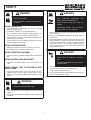
WARNING
WARNING
Engines give off carbon monoxide, an
odorless, colorless, poison gas.
Unintentional sparking can result in fire
or electric shock.
Breathing carbon monoxide can cause
nausea, fainting or death.
Unintentional start-up can result in
entanglement, traumatic amputation,
or laceration.
• Start and run engine outdoors.
• Do not start or run engine in enclosed area, even if doors
or windows are open.
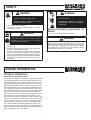
BEFORE PERFORMING ADJUSTMENTS OR
REPAIRS
WARNING
• Disconnect battery at negative terminal.
Never remove radiator cap or radiator reservoir
cap while the engine is hot or running. Severe
thermal burns or injury can occur by escaping
steam or hot engine coolant.
WARNING
Briggs & Stratton does not approve or authorize the use of
these engines on 3-wheel All Terrain Vehicles (ATVs), motor
bikes, fun/recreational go-karts, aircraft products or vehicles
intended for use in competitive events. Use of these engines in
such applications could result in property damage, serious
injury (including paralysis), or even death.
• Stop engine and allow to cool before removing radiator or
reservoir cap.
• To remove reservoir cap after engine is cool, place a thick
cloth over cap and remove it slowly.
• To remove radiator cap after engine is cool, place a thick
cloth over cap and rotate it slowly counter-clockwise to
the first stop. Pressurized steam may emit from the cap,
stand back to avoid injury. Once all pressure is released,
rotate cap counter-clockwise while pushing down on cap
to remove.
ENGINE INFORMATION
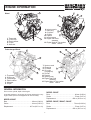
TECHNICAL INFORMATION
Engine Power Rating Information
The gross power rating for individual gas engine models is labeled
in accordance with SAE (Society of Automotive Engineers) code
J1940 (Small Engine Power & Torque Rating Procedure), and rating performance has been obtained and corrected in accordance
with SAE J1995 (Revision 2002-05). Torque values are derived at
3060 RPM; horsepower values are derived at 3600 RPM. Actual
gross engine power will be lower and is affected by, among other
things, ambient operating conditions and engine-to-engine variability. Given both the wide array of products on which engines are
placed and the variety of environmental issues applicable to operating the equipment, the gas engine will not develop the rated
gross power when used in a given piece of power equipment (actual “on-site” or net power). This difference is due to a variety of factors including, but not limited to, accessories (air cleaner, exhaust,
charging, cooling, carburetor, fuel pump, etc.), application limitations, ambient operating conditions (temperature, humidity, altitude), and engine-to-engine variability. Due to manufacturing and
capacity limitations, Briggs & Stratton may substitute an engine of
higher rated power for this Series engine.
4