1
Using a PC
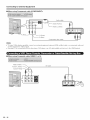
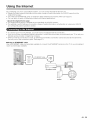
Example
AQUOS
NET
APPS
I
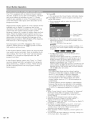
This function
audio.
sets the terminal
to output
the computer
The adjustment
items vary depending on the input
source. Select the input source corresponding
to the
terminal connected
to the PC and then adjust the
desired item.
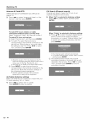
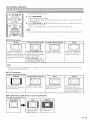
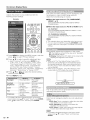
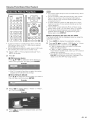
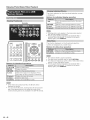
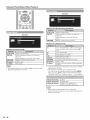
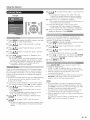
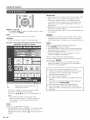
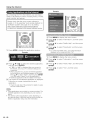
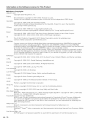
1 Press MENU to display the MENU screen, and then
press 4/1_ to select "System Options".
2 Press A/V to select "Input Terminal Setting", and
then press ENTER.
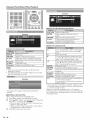
3 Press A/T to select "PC input" or "Audio Select",
and then press ENTER.
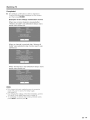
4 Press A/V to select a specific adjustment item,
and then press ENTER to set each item.
5 Press A/V (or 4/1_) to select or adjust the desired
setting, and then press ENTER.
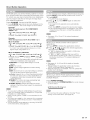
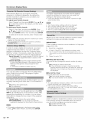
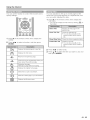
For automatically
adjusting the PC image.
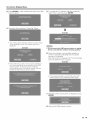
Yes: Auto Sync. starts and "Now adjusting the image."
displays.
No: This function does not work.
= When "Auto Sync." is successful, "Completed" displays. If
not, "Auto Sync." failed.
= "Auto Sync." may fail even if "Completed" displays.
o "Auto Sync." may fail if the computer image has low
resolution, has unclear (black) edges, or is moved while
executing "Auto Sync.".
o Be sure to connect the PC to the TV and switch it on before
starting "Auto Sync.".
PC IN
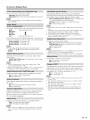
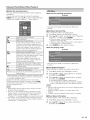
Video: Select this when the TV and PC are connected
using an analog RGB cable and the audio is not input.
Video+Audio:
Select this when the TV and PC are
connected using an analog RGB cable and the audio is
input via a ® 3.5 mm stereo minijack.
m HDMI
o When "Audio Select" is set to "HDMl(Digital)", sound will
not be produced if you use only an HDMI-certified cable to
connect HDMI-compatible equipment. To produce sound,
you should make an analog audio connection.
o If you want to connect HDMI-compatible equipment
using only an HDMI-certified cable, set "Audio Select" to
"H DMl(Digital)".
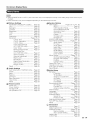
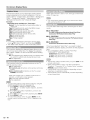
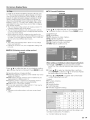
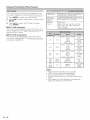
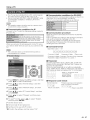
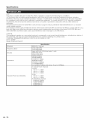
It is necessary to set the PC correctly to display XGA
and WXGA signal.
Resolution
VGA
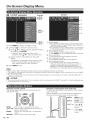
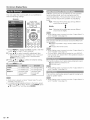
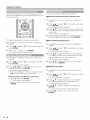
Ordinarily you can easily adjust the picture as necessary
to change image position using "Auto Sync.". In some
cases, however, manual adjustment
is needed to
optimize the image.
N-Pos.: Centers the image by moving it to the left or right.
V-Pos.: Centers the image by moving it up or down.
Clock: Adjust when the image flickers with vertical
stripes.
Phase: Adjust when characters have low contrast or
when the image flickers.
o For resetting all "Fine Sync." adjustment items to the factory
preset values, press A/Y to select "Reset", and then press
ENTER.
o It is not necessary to adjust the "Clock" or "Phase" when a
digital signal is being input, so it cannot be selected.
o The default cursor position may not be in the center,
because the screen position variable ranges may be
asymmetrical.
o The screen position variable ranges depend on the View
Mode or the signal type. The ranges can be seen on the
position-setting screen.
Q-
56
1
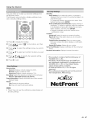
HDMl(Digital}:
Select this when the TV and PC are
connected using an HDMI-certified cable and audio is
input via the same cable.
HDMl+Analog:
Select this when the TV and PC are
connected using a DVI-HDMI conversion cable and the
audio is input via a ® 3.5 mm stereo minijack.
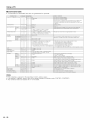
Horizontal
Vertical
VESA
Frequency Frequency Standard
720 x 400
31.5 kHz
70 Hz
640 x 480
31.5 kHz
37.9 kHz
37.5 kHz
60 Hz
72 Hz
75 Hz
O
O
O
56
60
72
75
60
70
Hz
Hz
Hz
Hz
Hz
Hz
O
O
O
O
O
O
SVGA
800 x 600
XGA
1024 x 768
35.1
37.9
48.1
46.9
48.4
56.5
kHz
kHz
kHz
kHz
kHz
kHz
WXGA
1360 x 768
60.0 kHz
47.7 kHz
75 Hz
60 Hz
O
O
SXGA
SXGA+
1280 x 1024
1400 x 1050
64.0 kHz
65.3 kHz
60 Hz
60 Hz
O
O
UXGA
1600 x 1200
75.0 kHz
60 Hz
O
1080p
1920 x 1080
67.5 kHz
60 Hz
VGA
and XGA
are registered
trademarks of International
Business
Machines
Corp.
l
|