1
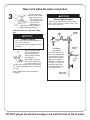
Now let’s connect the water to dispenser
4
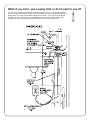
Before you start, open
the valve and let a small
amount of water run through it
into a pan. This will flush the
line of sediment.
A
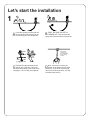
Bend and position the 1/4"
copper line coming from
the dispenser so that it fits into
the shutoff valve. With one
hand, support the copper line
as it comes out of the tank and
bend the tube with the other
hand. Bend the tube carefully.
Do not to kink it.
B
When connecting to a
compression type fitting
tee or valve, remove the nut
and ferrule (a rounded brass
fitting) from the valve. Then,
place the nut followed by the
ferrule over the end of the
tube coming from the dispenser.
C
Push the tube end all the
way into the valve or tee
fitting. Hold the tube end in
position and push the ferrule
down as far as it will go. Now,
tighten the nut over the ferrule
with your fingers. Make sure
the tube end is going straigh
into the hole. Then tighten the
nut firmly with a 1/2" wrench.
D
Flow restriction
• Make sure the bends in tubing are smooth and not kinked.
• Don’t use paste-type sealants on water line connections.
• Tighten compression fittings snug but don’t overtighten.
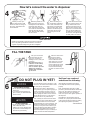
FILL THE TANK
5
Valve
Lever
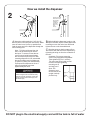
First, open the shutoff
valve all the way and
see if your connection is
watertight. If it isn't, redo your
connection.
Important: Never place a
restriction on the delivery
of water from the spout.
Such a restriction prevents
draining the expansion
chamber and could damage the tank.
A
Place the valve lever in
the down position.
Press down on the valve
lever and fill the tank until
water freely runs out of the
spout. Release the valve
lever and the faucet should
turn off. Operate the valve
lever several times letting
the water run to flush out the
lines.
B
DO NOT PLUG IN YET!
6
Fire/Product Damage
• Do not remove or alter the thermal
safety fuse.
• If you suspect the thermal fuse is
open, contact your ISE Authorized
Service Center
Product Damage
• Do not connect electric power until
tank is filled with water.
Failure to do so may damage heating element or thermal safety fuse
and will void your warranty.
Until you have read and
understood the following:
Once the electrical cord is plugged in, it will
take ten to 15 minutes for the water to reach
its 190°F (88°C)* temperature.
(See adjusting temperature procedure).
Your dispenser should now be operating
properly.
When the 190°F (88°C)* temperature is
being reached, you can expect a gurgling or
hissing sound within the tank. This is normal. You might also experience steaming
and/or spitting hot water to come out of the
faucet without turning it on. This also is a
normal function on any initial start up.
Note: The dispenser perks like a coffee
percolator just before the electric thermostat
shuts it off. The rumble is caused by gas
bubbles being driven off by the boiling
water. This is part of the regular operation of
the dispenser.
Now, carefully turn on the faucet for about
20 seconds to draw off that steaming water
and allow the water in the tank to reheat.
Repeat this step one or two more times. This
allows the functional parts of the dispenser
to heat up evenly and work in balance, preventing the steaming and spitting condition.
If steam is still emitted from the faucet, a
thermostat adjustment may be necessary to
slightly decrease the water temperature.
High altitudes: High elevations (Denver,
Colorado, etc.) may require the thermostat
to be lowered to keep the water from boiling
(see adjusting temperature procedure).
*APPROXIMATE