1
CyberSerial Dual
ExpressCard
Quick Installation Guide
Introducing the CyberSerial ExpressCard
The CyberSerial Dual ExpressCard adds two high-speed
serial ports to an ExpressCard equipped computer.
Features and Benefits
•
•
•
•
Compatible with hi-speed modems, monitoring
equipment, serial networking and other serial
devices
Two DB9 RS232 ports with 16550 UART
Supports data rate of up to 115 Kbps
Built-in 16-byte FIFO buffers dramatically increase
data transmit/receive speed, especially under
Windows multitasking environment
System Requirements
•
•
Notebook or desktop computer with an available
ExpressCard slot
Windows 2000/XP/Server 2003
Package Contents
•
•
•
•
CyberSerial Dual ExpressCard
2-port DB9 Fan-out Cable
Driver CD
Quick Installation Guide
04-0414A
1
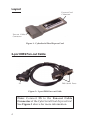
Layout
ExpressCard
Connector
Fan-out Cable
Connector
Figure 1: CyberSerial Dual ExpressCard
2-port DB9 Fan-out Cable
DB9 Serial Ports
2S
Figure 2: 2-port DB9 Fan-out Cable
Note: Connect 2S to the Fan-out Cable
Connector of the CyberSerial Dual ExpressCard.
See Figure 1 above for more information.
2
Hardware Installation
General instructions for installing the ExpressCard are
provided below. Since the design of notebook computers
vary, refer to your system’s reference manual for further
information, if needed.
1.
Insert the CyberSerial Dual ExpressCard into the
ExpressCard slot of the computer with it's Express
Card Connector facing the slot. Push the card into
the slot gently, yet firmly for a solid connection.
Note: Some ExpressCard slots will click when the
ExpressCard is fully inserted into the slot.
2.
Connect 2S of the fan-out cable to the Fan-out Cable
Connector of the CyberSerial Dual ExpressCard. See
Figure 1 and 2 on page 2 for more information.
Note: Make sure that the CyberSerial Dual ExpressCard
does not move side to side when connecting the fanout cable, otherwise the ExpressCard may
accidentally eject from the slot.
3.
If your system was powered off when you plugged
in the ExpressCard, turn it on and go to Driver
Installation on page 4. Otherwise, go directly to
Driver Installation on page 4.
3
Driver Installation
This section provides information on how to install the
CyberSerial Dual ExpressCard drivers.
Windows 2000
1.
2.
3.
4.
5.
6.
7.
At the Found New Hardware Wizard, click Next.
Select Search for a suitable driver for my device
(recommended), and click Next.
Check Specify a location, uncheck the other boxes,
then click Next.
Insert the driver CD, type in D:\2000, then click OK.
(Change D: to match your CD-ROM drive letter)
Click Next and Finish.
Repeat steps 1-5.
Restart Windows to complete the installation.
Windows XP
1.
2.
3.
4.
5.
6.
4
At the Found New Hardware Wizard, select No, not
this time, then click Next.
Select Install from a list or specific location
(Advanced), then click Next.
Insert the driver CD, check Include this location in
the search, uncheck the other box, type in D:\XP,
and click Next. (Change D: to match your CD-ROM
drive letter)
If the Hardware Installation window pops up, click
Continue Anyway, then Finish. Our driver has been
thoroughly tested for stability and compatibility.
Repeat steps 1-4 two times.
Restart Windows to complete the installation.
Windows Server 2003
1.
2.
3.
4.
5.
6.
At the Found New Hardware Wizard, select No,
not this time, then click Next.
Select Install from a list or specific location
(Advanced), then click Next.
Insert the driver CD, check Include this location in
the search, uncheck the other box, type in D:\2003,
and click Next. (Change D: to match your CD-ROM
drive letter)
If the Hardware Installation window pops up, click
Continue Anyway, then Finish. Our driver has been
thoroughly tested for stability and compatibility.
Repeat steps 1-4 two times.
Restart Windows to complete the installation.
To Verify Windows 2000/XP/2003 Installation
1.
2.
Right click My Computer, click Manage, then click
Device Manager.
Click on the + (plus sign) in front of Ports (COM &
LPT), USB-to-Serial Port... should be displayed
two times.
Changing COM Port Number
Some serial devices need a specific COM port in order to
work. If your serial device works properly, do not
change this setting.
1.
2.
From the Device Manager window double click
Ports (COM & LPT), then double click the serial
port you want to change.
Click Features tab.
5
3.
4.
Click the down arrow that is next to the COM Port
Number box, select a COM port that is not in use,
then click OK.
Close Device Manager to save the changes.
Removing the ExpressCard
Before ejecting the CyberSerial Dual ExpressCard from the
ExpressCard slot, first use the Safely Remove Hardware
utility to stop it. Not following the steps below could
lead to system crashes, data corruption or data loss.
Follow the steps below for your version of Windows.
For Windows 2000
1.
Click the Unplug or Eject Hardware icon located in
the taskbar by the system clock.
2.
Click Stop USB Compound Device.
3.
At the Safe To Remove Hardware box, click OK.
The CyberSerial Dual ExpressCard can be ejected.
For Windows XP/Server 2003
1. Click the Safely Remove Hardware icon located in
the taskbar by the system clock.
2.
Click Safely remove USB Compound Device.
3. When the Safe to Remove Hardware box pops up,
the CyberSerial Dual ExpressCard can be ejected.
6
Technical Support and Warranty
QUESTIONS?
SIIG’s Online Support has answers!
Simply visit our website at www.siig.com and click on Support.
Our online support database is updated daily with new drivers
and solutions. Answers to your questions could be just a few clicks
away. You can also submit questions online and one of our technical
support analysts will promptly respond.
A 5-year manufacturer warranty supplied with this product is
offered by SIIG, Inc. Please see SIIG website for more warranty
details. If you should happen to encounter any problems with this
product, please follow the procedures below.
If it is within the store's return policy period, please return the
product to the store where you purchased from.
If your purchase has passed the store's return policy period, please
follow these steps to have the product repaired or replaced.
Step 1: Submit your RMA request.
Go to www.siig.com, click Support, then RMA to submit a
request to SIIG RMA. If the product is determined to be
defective, an RMA number will be issued. SIIG RMA department
can also be reached at (510)413-5333.
Step 2: After obtaining an RMA number, ship the product.
• Properly pack the product for shipping. All software, cable(s)
•
•
and any other accessories that came with the original package
must be included.
Clearly write your RMA number on the top of the returned
package. SIIG will refuse to accept any shipping package, and
will not be responsible for a product returned without an
RMA number posted on the outside of the shipping carton.
You are responsible for the cost of shipping the product to SIIG
at the following address:
SIIG, Inc.
6078 Stewart Avenue
Fremont, CA 94538
RMA #:
• SIIG will ship the repaired or replaced product via Ground
in the U.S. and International Economy outside of the U.S. at
no cost to the customer.
7
About SIIG, Inc.
Founded in 1985, SIIG, Inc. is a leading computer upgrade manufacturer
of I/O connectivity products, including PCI & ISA serial and parallel
ports, USB, Serial ATA & UltraATA controllers, FireWire (1394a/b),
Networking, Sound Cards, and other accessories. SIIG is the premier
one-stop source of upgrades.
SIIG products offer comprehensive user manuals, many user-friendly
features, and are backed by an extensive manufacturer warranty.
High-quality control standards are evident by the overall ease of
installation and compatibility of our products, as well as one of the
lowest defective return rates in the industry. SIIG products can be
found in computer retail stores, mail order catalogs, and e-commerce
sites in the Americas and the UK, as well as through major distributors,
system integrators, and VARs.
PRODUCT NAME
CyberSerial Dual ExpressCard
FCC RULES: TESTED TO COMPLY WITH FCC PART 15, CLASS
B OPERATING ENVIRONMENT: FOR HOME OR OFFICE USE
FCC COMPLIANCE STATEMENT:
This device complies with part 15 of the FCC Rules. Operation is
subject to the following two conditions: (1) This device may not cause
harmful interference, and (2) this device must accept any interference
received, including interference that may cause undesired operation.
THE PARTY RESPONSIBLE FOR PRODUCT COMPLIANCE
SIIG, Inc.
6078 Stewart Ave.
Fremont, CA 94538-3152
CyberSerial Dual ExpressCard is a trademark of SIIG, Inc.
SIIG and SIIG logo are registered trademarks of SIIG, Inc. Microsoft and Windows are
registered trademarks of Microsoft Corporation. Other names used in publication are for identification
only and may be trademarks of their respective companies.
January, 2006
Copyright ©2006 by SIIG, Inc. All rights reserved.