1
About Compression
The dynamic range of a sound is the difference between its loudest and softest points.
For example, as you play your bass, you’ll probably find that some notes (for example,
notes played on the upper frets of the lowest string) are considerably louder than others.
The function of the compressor in the Model 1400/1415 Bass Amplifier is to reduce overall dynamic range by automatically attenuating the loudest sounds input so that they are
closer in level to softer ones—the end result is that the sound “evens out” and all notes
played have pretty much the same level.
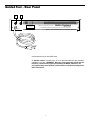
COMPRESSION
COMPRESSION OFF
ON
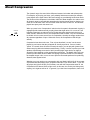
When you press in the “Compression” switch on the front panel, this automatic circuitry is
engaged and the loudest sounds you play (those that might cause 1% or more of Total
Harmonic Distortion) are reduced in level so that they more closely match the level of
softer sounds—when this occurs, the Compression LED will flash. Very loud sounds will
be limited—this is a more severe form of compression, whereby the output remains virtually constant regardless of input. When this occurs, the Compression LED will light
steadily.
Compression has three main uses. First, as just described, it “evens” out the notes
played by your bass so that they all appear at virtually equal level. Second, it adds
“punch” to a sound; since all levels are nearly the same, you can play with greater force
without worrying about the loudest notes distorting. Finally, it serves to protect your loudspeakers from damage as a result of brief (transient) high output levels, as might be
caused by finger-popping or other performance techniques. The Model 1400/1415 compression circuit uses a function called soft clipping to prevent sounds from overloading
the amplifier output—this, in turn, serves to prevent connected speakers from producing
distorted, hard clipped sound.
Whether or not you need to use compression with your Model 1400/1415 will be a matter
of personal taste and playing style—experiment and see if you like the effect. If you usually play at low Volume levels, you’ll find that, even with the Compression switch in, the
Compression LED doesn’t flash or light at all—in this case, the circuitry isn’t being used
anyway, so it might as well be off. In general, if you don’t need compression, leave it off.
13