1
9.7 SRC
The DMC-842 includes eight individually switchable sample rate converters (SRC). The technical specifications indicate an exceptional conversion quality, formerly known only from synchronous SRC devices. The conversion in full 24 bit resolution operates practically without loss of
signal quality, so no audible artifacts or noise are added.
The SRC of the DMC-842 offers a maximum conversion rate of 1:7 or 7:1, respectively. Thus,
192 kHz can be converted to any sample rate down to 32 kHz, and 32 kHz can be converted to
any frequency up to 192 kHz.
When using the internal clock, every SRC also works as a jitter killer. However, the DMC-842 is
equipped with SteadyClock, thus operating as perfect jitter killer with any clock source.
An SRC not only converts sample rates, it also serves as a clock decoupler. With SRC active,
even non-synchronizable devices (CD-players, DAT machines, etc.) can be used in a setup of
digital devices, just as if they were externally synchronized. The SRC decouples input and output clock, sets the output clock to the common reference, thus allowing the combination of different clock-sources without any clicks or dropouts. This is exactly what happens when using
digital microphones in Mode 1.
9.8 PAR
After pressing the PAR button below the rotary encoder the DMC-842 enters the Parameter
menu. Turning the encoder knob scrolls through all the available options. More information can
be found in chapter 11.
9.9 Sync
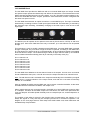
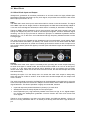
The DMC-842 has 8 independent digital inputs. In order to avoid clicks and drop outs due to
faulty or missing synchronicity, a special process called SyncCheck analyzes the incoming
data.
Each input has its own SYNC LED. If a valid input signal is applied, SyncCheck is active automatically. SyncCheck takes the chosen clock (internal, external, etc.) as reference and compares it with the input clocks. Inputs which are not synchronous will be signalled by flashing of
the corresponding SYNC LED.
18
User’s Guide DMC-842 © RME