1
5.3 Notes on Power Supply
• The CardBus card delivers no power to the Digiface. Therefore a hi-tech switching power
supply is included.
• The PCI card operates as power supply for the attached Digiface via the FireWire cable. An
external power supply is not required.
The Digiface draws a high startup current of more than 2.5 A during initialisation. Current at 12
Volt operating voltage: unloaded 200 mA (2.5 Watts), loaded 400 mA (4.8 Watts). Supply voltage range DC 8 V – 28 V, AC 8 V – 20 V.
6. First Usage – Quick Start
6.1 Connectors and Front Panel
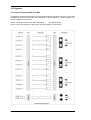
The front of the Digiface features a MIDI input and output, a stereo headphone output and several status LEDs.
MIDI I/O 2 represent the second MIDI input and output, realized as 5-pin DIN jacks.
The LEDs MIDI IN and OUT indicate sent or received data for the MIDI ports.
The INPUT STATE LEDs (WC, SPDIF, ADAT) indicate a valid input signal separately for each
digital input. Additionally, RME's exclusive SyncCheck indicates if one of these inputs is
locked, but not synchronous to the others, in which case the LED will flash. See also chapter
11.2 / 20.2, Clock Modes - Synchronization.
The red HOST LED lights up when the power supply or the computer is switched on, thus signalling the presence of operating voltage. At the same time it operates as Error LED, in case
the I/O-box wasn’t initialised, or the connection to the interface has been interrupted (Error,
cable not connected etc.). It flashes then. After the firmware had been loaded the LED turns
off, signalling a proper operation.
The rear panel of the Digiface has the MIDI I/O 1, three ADAT optical I/Os, the power socket
AUX (only necessary with CardBus operation), ADAT Sync input, Word Clock I/O, and the coaxial SPDIF input and output.
ADAT I/O 1-3 (TOSLINK): ADAT1 can also be used as optical SPDIF input and output, if set up
accordingly in the Settings dialog. The Settings dialog is started by clicking on the hammer
symbol in the Task Bar's system tray.
SPDIF I/O coaxial (RCA): Fully AES/EBU compatible by transformer-coupling and level adjustment. The Digiface accepts the commonly used digital audio formats, SPDIF as well as
AES/EBU.
Word Clock I/O (BNC). The word clock input is not terminated.
ADAT Sync In for connection to ADAT Sync of an ADAT recorder. Allows for sample-accurate
synchronization with ASIO 2.0.
8
User's Guide HDSP System Digiface © RME