1
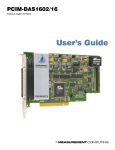
PCI-DAS1602/12 User's Guide
Functional Details
Analog inputs
The PCI-DAS1602/12 provides eight differential inputs, or 16 single-ended analog inputs. The input mode is
software selectable, with no switches or jumpers to set. The board offers a 330 kHz maximum sample rate in
single and multi-channel scans at any gain setting. A 1024 sample FIFO assures data taken from the board is
transferred into computer memory without the possibility of missed samples.
Software also selects the bipolar/unipolar input configuration as well as selecting among the input ranges. The
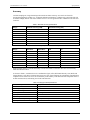
table below lists the input ranges and resolutions for the available input configurations and gains.
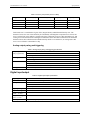
Input range and resolution
Bipolar Range
Resolution
Unipolar Range
Resolution
±10 V
±5 V
±2.5 V
±1.25 V
4.88 mV
2.44 mV
1.22 mV
0.61 mV
0 to 10 V
0 to 5 V
0 to 2.5 V
0 to 1.25 V
2.44 mV
1.22 mV
0.61 mV
305 µV
Burst mode
Channel-to-channel skew results from multiplexing the A/D inputs. Channel-to-channel skew is defined as the
time between consecutive samples. For example, if four channels are sampled at a rate of 1 kHz per channel,
the channel skew is 250 µs (1 ms/4).
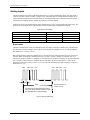
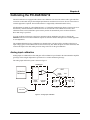
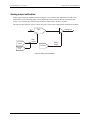
Burst mode minimizes channel-to-channel skew by clocking the A/D at the maximum rate between successive
channels. Burst mode timing is illustrated in Figure 4. At the 1-ms pulse, channel 0 is sampled. After 3 µs,
channel 2 is sampled. Channel 3 is sampled 3 µs after channel 2 is sampled. No samples are then taken until the
next 1-ms pulse, when channel 0 is sampled again. In this mode, the rate for all channels is 1 kHz, but the
channel-to-channel skew (delay) is now 3 µs, or 9 µs total. The minimum burst mode skew/delay on the PCIDAS1602/12 is 3 µs.
CH0
CH1 CH2 CH3
CH0
CH1 CH2
CH3
3 µS
Dela y
Burst mode pacer is
fixed at 3.0 µS
The length of the delay between bursts is
set by one of the internal counters, or may
be controlled via the external trigger.
Figure 4. Burst mode timing
17