1
RX120 digital rhythm
programmer.
to TRACK 2, the original information will be
erased and replaced by the new recording.
So, in Record mode, MIDI information
received is recorded onto TRACK 1. This data
on TRACK 1 can be moved to TRACK 2 by
means of EXCHANGE (Job B-1), which
exchanges the data on TRACK 1 with the data
on TRACK 2. This is used most often after the
very first recording to exchange the newly recorded material on TRACK 1 with the blank
TRACK 2, prior to recording the first overdub.
To record the first overdub, pick a new MIDI
record channel (if desired), set TRACK 2 for
playback, and go into RECORD mode again.
You will then record on TRACK 1 while listening to the material already in TRACK 2.
After you have material on both TRACK 1
and TRACK 2, there are a number of useful Job
functions that allow you to combine the information in various ways.
Remember that multiple channels of MIDI
data can be stored on a single QX21 TRACK,
with MIDI channel integrity maintained for
each. For example, an instrument part can be
recorded via MIDI channel 1 on TRACK 1,
and exchanged (Job B-1) to TRACK 2; then a
second instrument part can be recorded on the
now blank TRACK 1 via MIDI channel 2. If
you are happy with both takes, you can track
down (Job B-3) the new material to TRACK 2.
This process can be repeated to create up to 16
separate parts on 16 MIDI channels.
The QX21 operates in much the same manner as its older brother, the QX7. For more
information on the operation of the QX7, see
the 7 System article in the November 1985 issue
of AfterTouch.
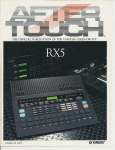
RX120 Digital Rhythm Programmer
Yamaha's new RX120 digital rhythm programmer takes a different approach to the creation of electronic drum and percussion parts. It
is designed for musicians who want an inexpensive drum machine that comes complete with a
large repertoire of preset patterns, covering a
wide range of musical styles. Instead of requiring the musician to create each stylistic pattern
before beginning the creation of a song structure, the RX120 provides a wide variety of
preset patterns, which can be combined into a
number of programmable song structures.
As with all electronic musical devices
designed for a specific purpose, the RX120 embodies a number of carefully-chosen trad~offs:
On the one hand, it is not possible to program
basic rhythm patterns into the unit; on the
other hand, it is not necessary to spend time
programming basic rhythm patterns into the
unit-this basic work has already been done.
The RX120 comes equipped with a full complement of 38 sampled percussive sounds,
including acoustic and electronic drum sounds,
percussion instruments, sounds effects, and two
Vol. 4 No. 8/ AFTERTOUCH
11