1
Operating Manual - ne24.24M Matrix Processor
Output Functions
8.2 Output Audio Functions
The following functions are available on all outputs: Mixer, High Pass/Low
Pass Filter, Delay, EQ, Gain, Limiter, and Mute.
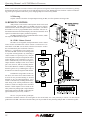
8.2a Output Matrix Mixer (Input Mixer)
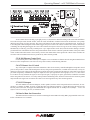
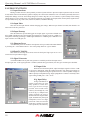
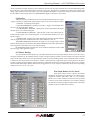
Output channels can have any or all inputs as sources, and the output matrix
mixer allows the level of each connected input to be adjusted in the “matrix mix” to
each output. Note that for a given output, unlinked inputs are disabled in the mixer.
Adjustment range is from +12dB to off. To set a level control to unity (0) within the
matrix mixer, select an input level control by clicking on it and pressing <ctrl> +
<click> on the level adjustment control. Individual input channels in the matrix mixer
can be muted independently from the main input or output mute blocks. An RD-8C
can be installed to remotely control the input levels for this ne24.24M output, if the
"Assign RD-8C" box is checked. Note: Only one RD-8C can be used per ne24.24M.
Ducking at the mixer can be enabled here as well.
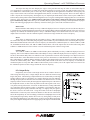
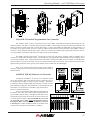
8.2b Hpf/Lpf - Crossover
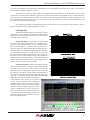
Bandpass or crossover functions on the Protea ne24.24M are available only on
the output channels. Every channel’s crossover consists of a high pass filter (HPF) and
a low pass filter (LPF), along with the frequencies and filter types used. Each output’s
crossover section is essentially a bandpass filter, making it necessary for the user to map
out ahead of time which outputs will be used for the various frequency bands, and set the overlapping filter frequencies and types
accordingly. Note: The High Pass Filter determines the lower frequency limit of the signal, while the Low Pass Filter determines the
upper frequency limit. Be careful not to accidentally send low frequency signals to high frequency drivers. Check the loudspeaker
specifications to determine a safe operating
frequency range. The
frequency range for the
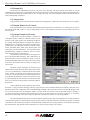
high pass filter (HPF) is
20Hz to 20kHz, with
an option to turn the
filter off at the low end
of the frequency selection. The low pass
filter (LPF) offers the
same frequency range,
with the “off” option
at the high end of the
frequency selection.
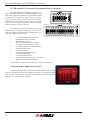
There are eleven types
of filters available in
the crossover section,
each suited to a specific
preference or purpose.
The slope of each filter type is defined by
the first characters in
the filter type, 12dB,
18dB, 24dB, or 48dB
per octave.
14