1
RIGID DUCTWORK
LIMITATIONS
ELECTRICAL REQUIREMENTS
IMPORTANT SAFETY PRECAUTIONS
Rigid metal ductwork should not exceed 54 feet
of straight 4 inch duct. Each 90° elbow and the
exhaust hood should be considered equivalent
to 8 feet of straight ductwork.
For example, if an exhaust hood and two 90°
elbows are used, the maximum straight duct
allowed would be 26 feet. Not more than three
90° elbows should be used in any rigid ductwork
run with an exhaust hood. Four feet of straight
duct should be allowed between 90° elbows.
WARNING: To prevent unnecessary risk of fire,
electrical shock or personal injury, all wiring and
grounding must be done in accordance with
local codes, or in the absence of local codes,
with the National Electrical Code, ANSI/NFPA
(for the United States) or the Canadian Electrical
Code, CSA C22.1 (for Canada). It is the
personal responsibility and obligation of the
appliance owner to provide adequate electrical
service for this appliance.
OBSERVE ALL NATIONAL CODES AND
LOCAL CODES AND ORDINANCES
GAS DRYER UNITS
A 120 volt, 60 Hz 15 ampere fuse electrical
supply is required. An individual branch (or
separate) circuit serving only this appliance is
recommended. DO NOT USE AN EXTENSION
CORD unless it meets all requirements as outlined for grounding, polarizing (3-wire) and
capacity. Wire size should be at least No. 14.
BEFORE OPERATING OR TESTING, follow
grounding instructions in Grounding section.
ELECTRICAL GROUNDING IS
REQUIRED FOR THIS APPLIANCE.
GROUNDING INSTRUCTIONS
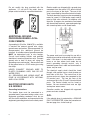
This appliance must be grounded. In the event
of malfunction or breakdown, grounding will
reduce the risk of electrical shock by providing a
path of least resistance for electric current. This
appliance is equipped with a cord having an
equipment-grounding conductor and a grounding plug. The plug must be plugged into an outlet that is properly installed and grounded in
accordance with all local codes and ordinances.
DANGER – Improper connection of the equipment-grounding conductor can result in a risk of
electric shock. Check with a qualified electrician
or serviceman if you are in doubt as to whether
the appliance is properly grounded.
printed in U.S.A.
5