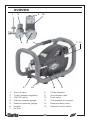
1
GENERAL SAFETY PRECAUTIONS
WORK AREA
1. Keep the work area clean and well lit. Floors should always be kept clear.
Cluttered or dark areas invite accidents.
2. Keep children and bystanders away while operating a power tool.
Distractions can cause loss of control.
3. The compressor should only be used in areas with adequate ventilation
and should not be exposed to heat or used near flammable substances.
PERSONAL SAFETY
1. ALWAYS stay alert, watch what you are doing and use common sense
when operating the compressor. Do not use the compressor while you are
tired or under the influence of medication, drugs or alcohol. A moment of
inattention can result in personal injury.
2. ALWAYS use eye protection when operating compressed air equipment,
and ensure that others in the work area are protected from flying particles
from the front and from the side.
3. ALWAYS protect yourself against electric shock. Never operate the
compressor in wet or damp locations.
4. NEVER over-reach. Keep your proper footing and balance at all times to
enable better control of the compressor in unexpected situations.
5. NEVER attempt any complex repairs yourself. If you have a technical
problem contact your local Clarke dealer.
6. ALWAYS store the compressor out of reach of children.
7. ALWAYS protect your hearing. Ear protection should be worn when
operating this compressor and it’s associated air driven power tools.
8. NEVER direct the air stream at people or animals, as injury may result.
Compressed air can cause soft tissue damage and propel dirt and other
particles at high speed.
9. NEVER touch hot surfaces. During operation, the motor, connections,
compressor body, cylinder head and tubes may get hot. Do not touch
these until the compressor has cooled down.
10. NEVER insert your fingers or other objects inside the motor housing. Never
operate the compressor without the cover in place.
GENERAL MACHINE USE AND CARE
1. Prior to use, all operators should become familiar with the instructions in
this booklet. In particular, become familiar with the ON/OFF control for
emergency stopping.
4