1
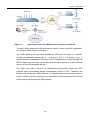
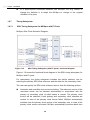
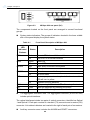
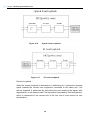
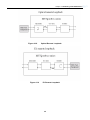
Chapter 1 Overview only to the VLAN member ports. Therefore, in addition to their functional value as tools for controlling traffic flow; port-based VLANs are an important security tool. The Ethernet switch enables defining port-based VLANs that include any of its four VCG Groups (which are connected to user-defined virtually concatenated groups in the range of 1 to 4), as well as the port connecting to the MUXpro management subsystem. However, any VLAN can include only one external LAN port out of the four connected to the Ethernet switch, that is, LAN 1, LAN 2, LAN 3 or LAN 4. Therefore, traffic received through one of these ports cannot reach the other port, although it can be forwarded through any desired group connected to the switch, and/or to the internal management port. See Figure 1-9, which illustrates the functionality of the two port-based VLANs that are defined in the MUXpro factory-default configuration: One port-based VLAN, designated VLAN Port 1, includes the MUXpro external port designated LAN 1, the management port, and groups 1 and 3 The other port-based VLAN, designated VLAN Port 2, and includes the MUXpro external port designated LAN 2, the management port, and groups 2 and 4. The factory-default configurations described above must ensure that the management subsystem can communicate through the external LAN ports LAN 1 and LAN 2, and through any of the virtually concatenated groups 1 to 4. Note: The factory-default configuration has been designed to separate between even and odd groups, but this is an arbitrary decision: an external port can connect to any, or all of the virtually concatenated groups connected to the Ethernet switch ports. The maximum number of port-based VLANs that can be defined is 20. For convenience, the user can also assign a logical name to each VLAN. 22