1
POWER CONDITIONING & UPS
OVERVIEW OF DIFFERENT UPS TYPES
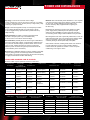
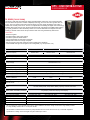
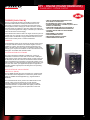
Most of the critical applications in data processing and other industries are now protected by Uninterruptible Power Supplies (UPS).
It is essential that the different types and performance levels are covered by international standards (IEC).
UPS systems are intended to improve the quality of AC power and provide a redundant (back-up) power source.
Power quality defects which may be improved by a UPS include surges, noise or sags.
AC
Input
Static
Switch
~=
Battery
Rectifier/
Charger
=~
Load
Inverter
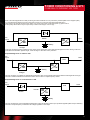
In this type of UPS the load is isolated from the mains, hence all the power to the load flows through the inverter, offering continuous
protection and full isolation against surges, noise and sags. It offers true on line protection.
Simplified Diagram of an “Offline“ UPS
AC
Input
Filter
~=
Battery
Rectifier/
Charger
Load
=~
Inverter
This type of UPS is not suitable for all applications because it does not use a static switch bypass and the switching times are longer.
There is no isolation between the load and the mains. There is also no output frequency control.
Simplified Diagram of an “Line-Interactive“ UPS
AC
Input
Transfer
Switch
Inverter
AVR
=~
Load
Battery
This type of UPS does not provide isolation between the mains and the load. There is poor protection against spikes and poor efficiency.
There is no output frequency control but it has voltage regulation on the output.
3