1
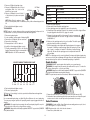
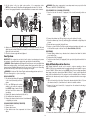
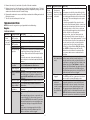
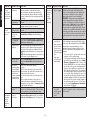
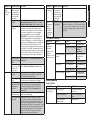
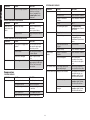
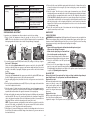
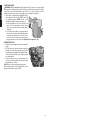
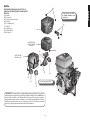
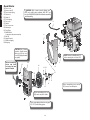
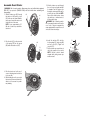
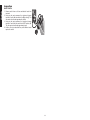
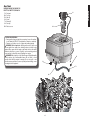
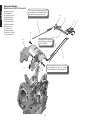
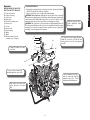
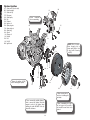
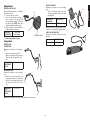
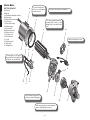
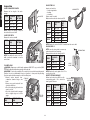
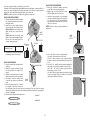
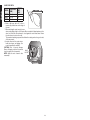
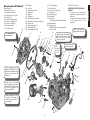
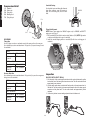
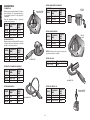
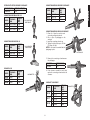
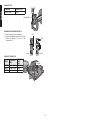
Cause Solution Excessive vibration/ knocking Loose/worn connecting rod Repair connecting rod Carbon in combustion chamber Clean carbon from chamber Bent crankshaft Disassemble crankcase and repair Engine mount damaged Check engine mounting bolts or replace rubber isolator Timing out Check flywheel key 8.Ensure the idle screw (with black spring under the head on the L-shaped lever on the solenoid) is backed out far enough to just clear touching the governor arm with idle control turned off. 9.Start the engine. Turn idle control on after engine has warmed up some. Solenoid should push governor arm and throttle to the left toward carburetor and the black plastic throttle should stop up against black plastic screw (L3, Q2). Adjust the idle speed to 2700–2800 RPM by adjusting this screw in to increase idle speed, back it out to reduce. If solenoid does not push lever over far enough to touch black plastic screw (the screw with the black spring on the L-shaped solenoid lever) can be turned in to make this happen. Both of these screws can be adjusted in our out so one is not at the extreme of it's adjustment length. 10.Cycle idle control switch on and off a few times and check both high speed and idle speed to ensure they are still correct. Perform Test Checks Ignition Test Speed/Governor Adjustment If speeds are out of adjustment use this procedure to reset to factory settings. 1.Back off both idle adjustment screws far enough so they are out of the way. NOTE: This is the black plastic screw (L3, Q2) at carburetor and the screw with the black spring under the head on the solenoid L-shaped linkage (if equipped). L3, Q2 C5 CHECK FOR SPARK WARNING: Risk of explosion. Spilled gasoline and it’s vapors can become ignited from sparks from smoking products, electrical arcing, exhaust, flame, gases and hot engine components such as the muffler. Make sure there are no sources of ignition, such as smoking products near servicing location. Wipe any fuel spillage from engine. WARNING: • Never hold the spark plug wire with wet hands while performing test. • Wipe any fuel spillage from engine. • Make sure the spark plug is not wet with fuel. • Do not allow sparks near the plug hole. 1.Remove the spark plug from the cylinder head. 2.Ground spark plug against air shroud as shown. 3.Place the on/off switch in the “ON” position and crank the engine. 4.Check to see if the spark bridges the electrode gap. If you can see the spark (this may be difficult in bright daylight) the problem is most likely not the ignition system. If spark plug fails to spark, see Flywheel Ignition Inspection. N5, Z4 F2 E5, Q5 2.Loosen the governor arm (E5, Q5) from the shaft (F2) coming out of the top of engine. On 9 and 13 HP engines: Rotate the shaft counterclockwise with the governor arm held to the right at WOT (wide open throttle). Make sure governor arm remains straight and does not pivot at the joint in the middle (if equipped). Retighten governor arm to shaft in this extreme position. On 6.5 HP engines: Rotate the shaft clockwise with the governor arm held to the right at WOT (wide open throttle). Retighten governor arm to shaft in this extreme position. 3.Governor spring (large silver) should be in the hole on the governor arm closest to the shaft. 4.Back out high speed adjustment screw (N5, Z4) on top of the engine at the small silver lever. A few complete turns will do. 5.Start the engine. If it hunts (speed varies up and down.), move the governor spring to the outer hole, if power is too low move it back in toward the shaft. NOTE: Hunting is unpredictable and sometimes the opposite movement of the spring helps. 6.Engine will probably be running slow. Adjust high speed to 3600 rpm by turning high speed screw (N5, Z4) on top, in to increase speed and out to slow down. If engine still runs to fast, governor arm may still be out of adjustment on shaft or it has moved since tightening. Or there could be an internal governor issue (this is rare). NOTE: If governor arm was over tightened to shaft and has no gap at the end of the arm next to the shaft, over tightening of the governor arm will not result in sufficient holding force to shaft. The governor arm must be replaced. 7.With engine off, ensure idle linkages on solenoid are not binding and are free to move the full travel. Also make sure throttle linkage from carburetor to governor arm moves back and forth freely. Oil Alert Test Perform this check if the engine will not start and other troubleshooting attempts have failed. Ensure oil is a proper level, see Oil under Maintenance. Engine will not start: Disconnect the lead from the oil alert sensor and directly connect the leads from the ignition switch and the ignition bypassing the low oil sensor. If the engine starts replace the sensor. Engine will not stop: With the engine running disconnect the oil alert sensor lead and ground it against the engine. If the engine does not stop replace the sensor. 21 English Problem