1
PRODUCT DESIGN
General Operation
The AMV9 and ACV9 furnaces are equipped with an electronic ignition device to light the burners and an induced
draft blower to exhaust combustion products.
An interlock switch prevents furnace operation if the blower
door is not in place. Keep the blower access doors in place
except for inspection and maintenance.
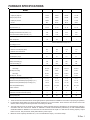
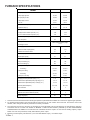
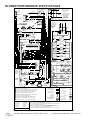
This furnace is also equipped with a self-diagnosing electronic control module. In the event a furnace component is
not operating properly, the control module LED will flash on
and off in a factory-programmed sequence, depending on
the problem encountered. This light can be viewed through
the observation window in the blower access door. Refer to
the Troubleshooting Chart for further explanation of the LED
codes and Abnormal Operation - Integrated Ignition Control section in the Service Instructions for an explanation of
the possible problem.
The rated heating capacity of the furnace should be greater
than or equal to the total heat loss of the area to be heated.
The total heat loss should be calculated by an approved
method or in accordance with “ASHRAE Guide” or “Manual
J-Load Calculations” published by the Air Conditioning Contractors of America.
*Obtain from: American National Standards Institute 1430
Broadway New York, NY 10018
Location Considerations
•
The furnace should be as centralized as is practical
with respect to the air distribution system.
•
Do not install the furnace directly on carpeting, tile,
or combustible material other than wood flooring.
•
When suspending the furnace from rafters or joists,
use 3/8" threaded rod and 2” x 2” x 1/8” angle as
shown in the Installation and Service Instructions. The
length of the rod will depend on the application and
clearance necessary.
When installed in a residential garage, the furnace
must be positioned so the burners and ignition source
are located not less than 18 inches (457 mm) above
the floor and protected from physical damage by vehicles.
Notes:
4. Installer must supply the following gas line fittings, depending on which entrance is used:
Left -- Two 90° Elbows, one close nipple, straight pipe
Right -- Straight pipe to reach gas valve.
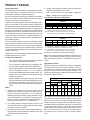
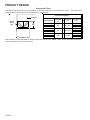
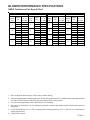
Accessibility Clearances (Minimum)
AMV9 MINIMUM CLEARANCES TO COMBUSTIBLE MATERIALS
(INCHES)
POSITION* FRONT SIDES REAR
TOP
FLUE FLOOR
Upflow
3
0
0
1
0
C
Horizontal
3
6
0
6
0
C
*=
All positioning is determined as installed unit is viewed from the front.
C= If placed on combustible floor, floor MUST be wood only.
NC= For instalaltion on non-combustible floors only. A combustible
subbase must be used for installations on combustible flooring.
ACV9 MINIMUM CLEARANCES TO COMBUSTIBLE MATERIALS
(INCHES)
POSITION* FRONT SIDES REAR
TOP
FLUE FLOOR
Upflow
3
0
0
1
0
NC
Horizontal
3
6
0
6
0
C
*=
All positioning is determined as installed unit is viewed from the front.
C= If placed on combustible floor, floor MUST be wood only.
NC= For instalaltion on non-combustible floors only. A combustible
subbase must be used for installations on combustible flooring.
36" at front is required for servicing or cleaning.
Note: In all cases accessibility clearance shall take precedence over clearances from the enclosure where accessibility clearances are greater. All dimensions are given in
inches.
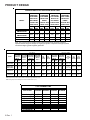
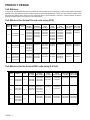
High Altitude Derate
When this furnace is installed at high altitude, the appropriate High Altitude orifice kit must be installed. This is required due to the natural reduction in the density of both
the gas fuel and combustion air as altitude increases. The
kit will provide the proper design certified input rate within
the specified altitude range.
•
1. Installer must supply one or two PVC pipes: one for
combustion air (optional) and one for the flue outlet (required). Vent pipe must be either 2” or 3” in diameter,
depending upon furnace input, number of elbows, length
of run and installation (1 or 2 pipes). The optional Combustion Air Pipe is dependent on installation/code requirements and must be 2” or 3” diameter PVC.
2. Line voltage wiring can enter through the right or left
side of the furnace. Low voltage wiring can enter through
the right or left side of furnace.
3. Conversion kits for propane gas and high altitude natural and propane gas operation are available. See High
Altitude Derate chart for details.
4 Rev. 1
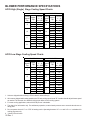
"STANDARD" and "HIGH ALTITUDE" KITS
0 - 7,000 Feet
(Standard Altitude)
7,001 - 9,000 Feet
9,001 - 11,000 Feet
Natural
Propane
ID Blwr
Pressure
Switch
AMV90453BXA
AMV90704CXA
No
Change
LPM-03
#55 Orifice
No
Change
HANG13
HALP11
#44
HAPS28
#56 Orifice
Orifice
HANG14
#45
Orifice
HALP11
#56
Orifice
HAPS28
AMV90905DXA
AMV91155DXA
No
Change
LPM-03
#55 Orifice
No
Change
HANG13
#44
Orifice
HALP11
#56
Orifice
HAPS29
HANG14
#45
Orifice
HALP11
#56
Orifice
HAPS29
ACV90704CXA
ACV90905DXA
No
Change
LPM-03
#55 Orifice
No
Change
HANG13
#44
Orifice
HALP11
#56
Orifice
HAPS29
HANG14
#45
Orifice
HALP11
#56
Orifice
HAPS31
Furnace
Gas Orifices
Gas Orifices
Natural
Propane
ID Blwr
Pressure
Switch
Natural
Propane
Gas Orifices
ID Blwr
Pressure
Switch
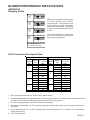
High altitude kits are purchased according to the installation altitude and usage of either natural or propane gas.
Refer to the chart above for a tabular listing of appropriate
altitude ranges and corresponding manufacturer’s high altitude Natural Gas and Propane Gas kits. For a tabular listing of appropriate altitude ranges and corresponding
manufacturer's High Altitude Pressure Switch kits, refer to
either the Pressure Switch Trip Points & Usage Chart in
this manual or the Accessory Charts in Service Instructions.