1
The instructions covering fitted equipment to
your caravan were correct at the time of going to print. Owners handbooks are updated
annually and we take great care to try and
ensure their accuracy. However, the Swift
Group Limited cannot accept responsibility for any changes that may be made in
specification or operating instructions to the
equipment described in this section after the
time of going to press.
Every care is taken to ensure that the information provided in this handbook is correct
and easy to understand.
Separate manufacturers’ leaflets on many
of the components are also included in the
Owner’s Pack provided with this caravan
and we recommend that you compare the
instructions in the handbook with the component manufacturers literature, to ensure
the information provided is as accurate as
possible.
If you are in any doubt as to how to operate the equipment in your caravan, please
contact the component manufacturer’s
service department on the telephone number shown on their component leaflet. If you
remain in any doubt, please contact your
supplying dealer.
These instructions are approved for The Alde
Compact 3010 boiler fitted in caravans, motor
caravans and buildings in accordance with CE
no. EMC e5 02 0138, 845 BP-0003.
Installation and repairs may only be carried out
by a professional. National regulations must be
adhered to.
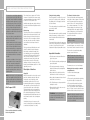
Alde Compact 3010
98
The boiler is fitted with a built-in warm water
heater with a volume of approx. 8.5-litres fresh
water. The warm water heater can produce
around 12 litres of 40°C water per half-hour
(at a cold water temperature of 10°C). If the
heating cartridges are used instead of gas
for heating the boiler, the capacity is slightly
reduced. Always rinse out the heater before
it is used, particularly if it has not been in
operation for some time.
The heating cartridge is controlled in the same
way as the gas boiler.
Warm water
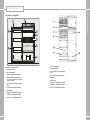
The boiler consists of three eccentrically- fitted
cylinders (heat exchanger, water jacket for the
heating system and, outermost, water jacket
for hot water). The two outer pipes, and their
ends and connections, are made of stainless
steel, while the heat exchanger is made of
aluminium.
When only warm water is required, for example
during the summer, no settings need to be
made, the boiler will look after this function
automatically.
The heat exchanger is divided into two semicircles. The burner is located in the upper
half, being the combustion chamber, and
the combustion gases are expelled through
the lower half. The burner unit is fitted on the
end of the heat exchanger. It consists of a
combustion fan, burner, solenoid valve and
intake/exhaust connections. Two heating
cartridges are fitted to the water jacket of the
heating system. Maximum output is 2 or 3 kW,
depending on model.
Description of functions
When LPG operation is selected on the control
panel, the combustion fan starts. When the
fan speed is correct, it signals the circuit
board that the boiler can be lit. The circuit
board sends ignition sparks to the spark plug
at the same time as it sends electricity to the
solenoid valve, which opens to allow gas in.
The burner ignites, and a sensor transmits a
signal back to the circuit board that the boiler
is lit, and the ignition spark stops. The burner
keeps burning until the boiler thermostat or the
room thermostat reaches the set temperature
reading.
Should the boiler go out for any reason, the
sensor is activated and a new attempt is made
to start the boiler (in about 10 seconds).
Please read these instructions carefully
before using the boiler.
The Domestic hot water heater
Electrical operation is selected on the control
panel, the 12-volt relays on the circuit board
trip, allowing the 230 volt supply to reach the
electrical elements.
Boiler design
Using LPG
Notice: In the interest of safety, replacement
parts for an appliance shall conform to the
appliance manufacturer’s specifications and
should be fitted by them or their authorised
agents.
Using the heating cartridge
The pump will only start when the temperature
in the vehicle is lower than the set temperature
(see item 4, Control Panel). If the vehicle
temperature is higher, the pump will not start.
Important information
• The boiler must not be started if there is no
glycol in the system.
• The LPG boiler and heating cartridge may be
operated in parallel.
Note: The hot water is not intended for
drinking or cooking.
When the heater is in continuous use, it should
be emptied approx. once a month, to ensure
that a new air cushion is formed in the heater.
The air cushion is essential for absorbing
pressure surges in the heater.
Note: The warm water heater should
always be drained of fresh water when there
is a risk of frost and when the caravan is not
in use.
• The heating system may be heated up
without the warm water heater being filled
with fresh water.
The warranty does not cover frost damage.
• Always switch off the main isolator for the
boiler when the vehicle is not being used.
1. Switch off the freshwater pump
• Always drain the warm water heater of fresh
water if there is a risk of frost.
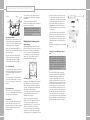
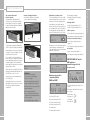
3. Then open the safety/drain valve by raising
the yellow lever (M) to a vertical position.
• The LPG boiler must not be operated when
refuelling the vehicle.
4. The heater will now drain directly below
the vehicle through the safety/drain valve
hose. Check that all the water is emptied out
(about 7-10 litres). Leave the valve in the open
position until the next time the heater is used.
• When washing the vehicle, take care not to
get water in the venting.
! WARNING: Care should be taken
to ensure adequate ventilation of the flue
at all times. Its is inadvisable to inhale
exhaust fumes.
F ITTE D E QUIPME NT
FIT T E D E QUIP M E N T
ALDE HEATING OPERATING INSTRUCTIONS
Draining the heater using the combined
safety/drain valve:
2. Open all water taps.
Note: Check that the automatic check valve
(N) is open and is allowing air to enter the
heater when it is being drained, and that the
hose (O) is not blocked.
99