1
APPLICATIONS
WARNING To reduce the risk of electric
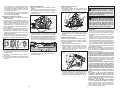
Cutting Large Panels
Large panels and long boards sag or bend if they
are not correctly supported. If you attempt to
cut without leveling and properly supporting the
workpiece, the blade will tend to bind, causing
KICKBACK.
Support large panels (Fig. 7). Be sure to set the
depth of the cut so that you only cut through the
workpiece, not through the supports.
shock, check work area for hidden pipes and
wires before making plunge cuts.
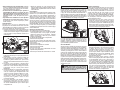
Plunge Cutting
Plunge cuts are made in the middle of the workpiece when it can not be cut from an edge. We
recommend using a Sawzall® reciprocating saw
or jig saw for this type of cut. However, if you must
use a circular saw to make a plunge cut, USE EXTREME CAUTION. To maintain control of the saw
during plunge cutting, keep both hands on the saw.
1. Beginning at a corner, line up the sight line with
your cutting line. Tilt the saw forward, firmly fixing
the front of the shoe on the workpiece (Fig. 8).
The blade should be just above cutting line, but
not touching it. Raise the lower guard using the
lower guard lever.
Fig. 7
Fig. 8
Overloading
Continuous overloading may cause permanent
damage to tool or battery pack.
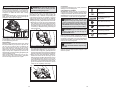
SYMBOLOGY
Volts
Cutting Masonry and Metal
MILWAUKEE circular saws are not intended for
continuous use in cutting metal or masonry. When
cutting these materials, use the correct blade. MILWAUKEE does not recommend using bonded abrasive wheels on circular saws for any application.
Direct Current
No Load Revolutions per
Minute (RPM)
WARNING
Dust, chips, and grit can
cause guard to hang up at any time. If saw
is used to cut masonry or metal, reserve and
mark it for that purpose only and return it to
a MILWAUKEE service facility for cleaning
and testing before using it for wood cutting.
Seal of Electrical Security
Read operator’s manual
WARNING Only use accessories with
maximum speed rating at least as high as
nameplate RPM of tool.
Wear hearing protection
Wear eye protection
When cutting masonry, use a diamond blade.
Make successive passes at depths of less than
6 mm (1/4") to achieve the desired depth. Cutting
at a depth of more than 6 mm (1/4") will damage
wheel. Remove battery pack and frequently clean
dust from air vents and guards.
Cross-Cutting Wood
Cross-cutting is cutting across the grain. Select the
proper blade for your job. Advance the saw slowly
to avoid splintering the wood.
Ripping Wood
Ripping is cutting lengthwise with the grain. Select
the proper blade for your job. Use a rip fence for
rips 101 mm (4") wide or less. To install the rip
fence, slide the bar through the rip fence slot in
either side of the shoe. The width of the cut is the
distance from the inside of the blade to the inside
edge of the rip fence. Adjust the rip fence for the
desired width, and lock the setting by tightening the
rip fence adjusting knob.
When ripping widths greater than 101 mm (4"),
clamp or tack 12 mm (1/2") lumber to workpiece
and use the edge of the shoe as a guide.
2. To start the saw, push the lock-off button down
while pulling the trigger. Allow the motor to reach
full speed before beginning cut. Using the front
of the shoe as a hinge point, gradually lower the
back end of the saw into the workpiece. Release
the lower guard lever and grasp the front handle.
3. When the shoe rests flat against workpiece,
advance the saw to the far corner (Fig. 9). Release the trigger and allow the blade to come to
a complete stop before removing it from workpiece. Repeat the above steps for each side of
the opening. Use a Sawzall® reciprocating saw,
jig saw or small hand saw to finish the corners
if they are not completely cut through.
WARNING Do not use tool for cutting
metal near flammable material. Sparks may
cause fire.
When cutting metal, use a metal cutting blade. Set
depth of cut to full depth. Protect everyone in the
area from sparks.
Fig. 9
28
29