1
1.4.3.3. Delete
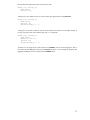
To delete a tuple from a particular table use the command DELETE FROM. The syntax is:
DELETE FROM table_name
WHERE condition;
To delete the supplier called ’Smith’ of the table SUPPLIER the following statement is used:
DELETE FROM SUPPLIER
WHERE SNAME = ’Smith’;
1.4.4. System Catalogs
In every SQL database system system catalogs are used to keep track of which tables, views
indexes etc. are defined in the database. These system catalogs can be queried as if they were
normal relations. For example there is one catalog used for the definition of views. This catalog
stores the query from the view definition. Whenever a query against a view is made, the system first
gets the view definition query out of the catalog and materializes the view before proceeding with
the user query (see Simkovics, 1998 for a more detailed description). For more information about
system catalogs refer to Date, 1994.
1.4.5. Embedded SQL
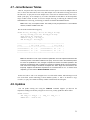
In this section we will sketch how SQL can be embedded into a host language (e.g. C). There are
two main reasons why we want to use SQL from a host language:
There are queries that cannot be formulated using pure SQL (i.e. recursive queries). To be able to
perform such queries we need a host language with a greater expressive power than SQL.
We simply want to access a database from some application that is written in the host language
(e.g. a ticket reservation system with a graphical user interface is written in C and the information
about which tickets are still left is stored in a database that can be accessed using embedded
SQL).
A program using embedded SQL in a host language consists of statements of the host language and
of embedded SQL (ESQL) statements. Every ESQL statement begins with the keywords EXEC
SQL. The ESQL statements are transformed to statements of the host language by a precompiler
(which usually inserts calls to library routines that perform the various SQL commands).
When we look at the examples throughout Select we realize that the result of the queries is very
often a set of tuples. Most host languages are not designed to operate on sets so we need a
mechanism to access every single tuple of the set of tuples returned by a SELECT statement. This
mechanism can be provided by declaring a cursor. After that we can use the FETCH command to
retrieve a tuple and set the cursor to the next tuple.
For a detailed discussion on embedded SQL refer to Date and Darwen, 1997, Date, 1994, or
Ullman, 1988.
21