1
Integrated Device Technology
REPEATERS
REPEATER FEATURES
•Supports automatic download of configuration
from external EEPROM with a single or multiple
repeaters on I2C bus
•Compensates for cable and PCB trace attenuation
and ISI jitter
•Power minimization in active and shutdown modes
•Programmable receiver equalization up to 30db
•No external bias resistors or reference
clocks required
•Programmable de-emphasis up to -8.5dB
•Recovers data stream even when the differential
signal eye is completely closed due to trace
attenuation and ISI jitter
•Channel mux mode, demux mode, 1 to 2 channels
multicast, and Z-switch function mode
REPEATER BENEFITS
•Full PCIe protocol support
•Extends maximum cable length to over
10 meters and trace length over 65 inches in
PCIe applications
•SAS/SATA, Out of Board (OOB) Support
•Configurable via external pins, while
extended programming ranges are available
via I2C interface
PCIe APPLICATIONS — REPEATERS
Blade
•Speeds up system design time by allowing
usage of longer trace and cable lengths
•Minimizes BER
Back Plane
Blade
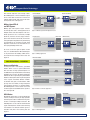
Blade Servers
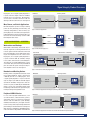
Blade servers inherently require the use of long
interconnects and multiple connectors to transfer signals between blades. IDT PCIe Repeaters
can be used to transmit boosted signals into
backplanes and to recover from long trace-related and connector-related signal attenuations
and jitter at the receiving end. See Figure 2.
Chipset
PCIe
(Trace)
Repeater
Repeater
PCIe
(Trace)
Chipset
x16 PCIe
(Trace)
Figure 2: Blade Server Application
Storage
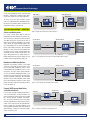
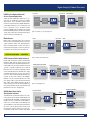
Similar to blade server applications, Storage Area
Networks (SAN) face a challenge of transferring
reliable PCIe signals between redundant storage
processors. IDT PCIe Repeaters can boost transmitted signals and restore noisy and attenuated
signals at the receiving end. See Figure 3.
Storage Processor Card
Chipset
PCIe
(Trace)
Mid Plane
Repeater
PCIe
(Trace)
Storage Processor Card
Repeater
PCIe
(Trace)
Chipset
PCIe
(Trace)
Chipset
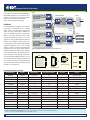
Cabled PCIe Systems
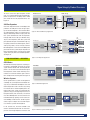
There are various system applications using
cables to transmit PCIe signals between chassis
(see Figure 4). Networking and storage equipment, medical instrumentation, data acquisition
systems such as scopes and protocol analyzers,
and peripheral devices are just a few examples
of PCIe cabled systems. IDT Repeaters permit the
use of less expensive and longer cables, allowing for significant savings and improving distance
constraints. Expensive PCIe cables can be replaced with less expensive ones for a significant
savings. See Figure 4.
Figure 3: Storage Application
System B
System A
Chipset
PCIe
(Trace)
PCIe
Repeater
(Cable)
Repeater
Notebooks and Docking Stations
PCIe connectors available in docking stations
need to pass the compliance test. This is a chal2 SIGNAL INTEGRITY PRODUCT FAMILY OVERVIEW
Figure 4: Cabled PCIe Application
IDT | THE ANALOG + DIGITAL COMPANY | www.IDT.com