1
time-triggered act.
TT2
time-triggered
domain
TT1
event-triggered
domain
ET1
time-triggered act.
idle
t
t1
t2
t3
t4
IRQ handler TT1
CPU Priority
IRQ handler TT2
OSEKtime
trigger priority
4
OSEKtime
execution priority
3
ET1 priority
1
idle priority
0
Task TT1
Task TT2
Task TT1
Task ET1
Task ET1
t
t1
t2
t3
t4
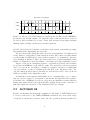
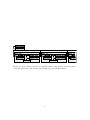
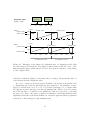
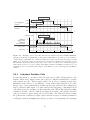
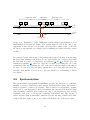
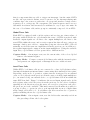
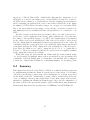
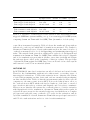
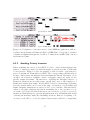
Figure 4.2: Example of the control flow and priority changes in a mixed OSEK/OSEKtime
application in Sloth on Time. The event-triggered task ET1 gets preempted by the activation
of time-triggered task TT1 at t1 , which in turn gets preempted by another time-triggered task
(TT2) at t2 . Both time-triggered activations are performed by a high-priority interrupt request
whose handler then lowers the CPU priority to the common execution level of all time-triggered
tasks. The priority level does not change when TT2 terminates and TT1 is resumed at t3 . On
termination of the only running time-triggered task TT1 at t4 , the event-triggered task ET1 is
resumed.
4.4.1
Individual Deadline Cells
For the first method, one timer cell is allocated per deadline. With regard to the
initial counter and compare values, the cells are configured identically to regular
task activations cells. Their request enable bit, however, remains cleared after
initialization and will not be set until the corresponding task is dispatched. For this,
the prologue of any task that has deadline monitoring enabled in its configuration
will be extended with static code that enables the triggering of interrupts in all
cells which represent deadlines for this particular task. When this task successfully
terminates in time—that is, without violating its deadline—the equally extended
epilogue clears the request enable bits for all deadline cells. This way, when reaching
the point in time at which a deadline expires after the monitored task has terminated,
it will pass without disrupting the current operation. Consequently, the interrupt
16