1
1 INTRODUCTION
1.1
WELCOME!
With NanoCore12, you are now ready to explore the power and versatility of
Freescale’s advanced 16-bit microcontroller family! Whether you’re new to Freescale
microcontrollers or you’ve used some of the earlier ones (such as 68HC05, 68HC11, or
68HC12), you’ll be impressed with the well thought-out design and implementation of the
HCS12 family. NanoCore12 gives you the opportunity to explore the 9S12C family’s
potential at a very affordable price! Add to that the proven advantages of it’s popular DIP
format, and you’ll see why you picked a real winner!
1.2
SUPPORT
To help you get the most out of this product, and to make the experience as
enjoyable and productive as possible, we’ve put together a comprehensive website, loaded
with resources, support, and applications information. If you experience any difficulties, or
need help with your application, the World Wide Web is arguably the most valuable resource available to you. There you’ll find the latest information, software, and troubleshooting help, as well as discussion groups where you can network with people around the
globe to get the answers you need. So if you still need help, or have questions after
reading this manual and perusing the contents of the included CD, visit our Support Forum:
www.technologicalarts.net and tap into the collective! Also, be sure to join Freescale’s
16-bit Microcontroller discussion group, at http://forums.freescale.com/freescale/
board?board.id=16BITCOMM
1.3
PRODUCT CONFIGURATION
NanoCore12 was designed as a versatile evaluation and application tool for the
Freescale HCS12 “C” family of microcontrollers. It is suitable for developing applications
for any of the derivatives (e.g. 9S12C32, 9S12C128). All of the subsystems are identical,
with the differentiating factor among the chips being the amounts of Flash and RAM
included on the chip. NanoCore modules are completely self-contained, including RS232
interface and 5V regulator circuitry right on the module. You can simply plug it into any
solderless breadboard to use it.
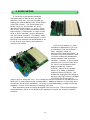
For added convenience, though, a Docking Module is offered, which provides additional support for working with the microcontroller. It includes a bigger voltage regulator
which has extra available current to spare for your applications. The voltage regulator also
has a jumper option for 3-Volt operation. Other features include a standard 9-pin D-sub
connector for the RS232 serial interface, a socket for the MCU module, a couple of user
LEDs and pushbuttons, and a snap-off prototyping area. A similar product, the School
Board, has a section of solderless breadboard instead of the snap-off prototyping area.
This configuration is ideal for quick experimentation and training purposes. Product
bundles are offered for both, and include a power supply, a serial cable, and a resource CD
containing this manual, example programs, software tools, and a collection of MCU documentation from Freescale. An optional CD containing the free 32K Special Edition of
Metrowerk’s CodeWarrior C compiler is available upon request.
NanoCore12 modules are offered in 24-pin, 32-pin, and 40-pin DIP footprints that
plug into the DIP socket on the Docking Module or the socket strips on a School Board.
While the standard configuration incorporates the 9S12C32 MCU, a 9S12C128 version is
also available on the 40-pin “MAX”, offering four times the program space (128K vs. 32K)
and double the RAM (4K vs. 2K).
1