1
FFT
Osciloscope
Audio
input
X
2
zero
crossing
+1
Lowpass filter
Bit
Recovery
DPLL
bandpass filters
BAUDOT/
ASCII
Terminal
Character
X
2
Recovery
-1
UART emulator
Demodulator
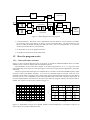
Figure 1.1: Block diagram of the rtty program.
• A sound-card driver. This driver can be compiled into the linux kernel or can be inserted as a module.
As previously stated, some drivers are buggy or lack some functionality. The SiS-7018 driver only
allows recording at 48 KHz sampling rate, and some “ioctl” calls are not implemented. As a result, the
oscilloscope window shows a poor animation.
• An X-window server for the graphical interface.
• An ANSI color terminal for the decoded output.
1.2
1.2.1
How the program works.
General decoder structure.
Figure 1.1 shows the block-diagram of the rtty program. It includes an FSK demodulation block, an UART
emulator block, a character terminal and some monitoring blocks.
The demodulator section takes audio samples as the input and generates a “0” or “1” logic level at the
output depending on the frequency of the input signal. This section is mainly based on digital filters, and works
as follows:
The input signal is filtered through a two bandpass filters. One filter is tuned to the MARK frequency while
the other is tuned to the SPACE frequency. As a result, two separated bands are obtained. Then, the “rms”
amplitude of each band is computed. This is achieved by squaring the band signals and then low-pass filtering
the result. The two “rms” amplitudes are then subtracted and the sign of the result is the logic output value. In
the actual implementation the subtraction and the low-pass filter are swapped, and only one low-pass filter is
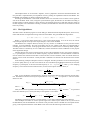
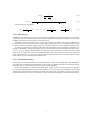
needed. The response of such section is shown in figure 1.2.
0.5
0.6
(b)
(a)
0.4
0.4
0.3
0.2
0.1
Output (a.u.)
Output (a.u.)
0.2
0
-0.1
0
-0.2
-0.2
-0.3
-0.4
-0.4
-0.5
400
600
800
1000
1200
1400 1600 1800
Frequency (Hz)
2000
2200
2400
-0.6
2600
0
50
100
time (ms)
150
200
Figure 1.2: Demodulator response for a 1000Hz, 1850Hz, 75 baud configuration. (a) Frequency response, (b)
Time response to a pseudo-random bit stream.
3