1
COMPACT
COMPACT Control System
Temperature regulation
Applies to COMPACT Unit & Top only
Applies to COMPACT Unit & Top only
Supply Air Regulation (control)
Outdoor Compensation
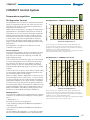
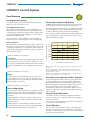
Supply air regulation involves keeping a constant supply air temperature without consideration to the load in the premises.
Temperature
Control Sequence
The temperature efficiency of the air handling unit’s heat exchanger is modulated to provide max. heat recovery.
After that, the air heater for reheating, if installed, will begin to
supply heat.
If an air heater for reheating the supply air is not installed, or
if the heating power in the air heater for reheating is not sufficient either, the supply air fan or both the supply air and the
exhaust air fans will automatically and variably be decelerated to
discharge supply air at the min. airflow setpoint.
A neutral zone can be preset, which allows a lower supply air
temperature setpoint before the downspeed fan control function begins.
As the supply airflow is controlled to a lower rate, the air pressure in the premise becomes sub-atmospheric and this instead
causes outdoor air to be sucked in through untight spots (leakage points) such as doors and windows. The ordinary heating
system of the premises must be sized for heating this outdoor
air.
Extract Air Regulation
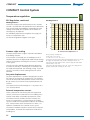
Extract air control involves keeping a constant temperature in
the extract air duct (the premises), by regulating the supply air
temperature.
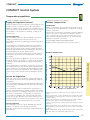
If the function is selected, the temperature setpoint is displaced
relative to the outdoor temperature according to a summer
curve or a winter curve. It is possible to set the slope of the
curves and their starting and end points. In conjunction with
supply air or extract air control only.
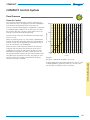
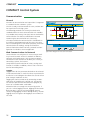
See the Outdoor Compensation Diagram below.
Negative summer compensation is also possible to preset.
Outdoor compensation
Y1
X1
X4
X2
COMPACT Control System
When the supply airflow is regulated to a lower rate, the heat
exchanger will have ”excess heat”, i.e. warm extract air, giving
it capacity to attain and maintain the supply air temperature
required.
Outdoor compensation can be activated if the premises are affected to an unusually high degree by cold and heat, via large
windows, for instance.
Y = Temperature displacement °C
Supply air regulation can be used when the load and temperatures of the premises are predictable. In most cases this requires
the installation of an air heater for reheating, possibly an air
cooler as well.
Y2
X3
The lowest and the highest permissible supply air temperatures
are specified while the COMPACT keeps the extract air temperature constant.
The result will be a uniform temperature in the premises regardless of the load. Extract air regulation requires the installation of an air heater for reheating, possibly an air cooler as well.
The extract air temperature is measured by the temperature
sensor inside the COMPACT unit. If this internal temperature
sensor does not give adequate representative extract air temperature readings, an external room temperature sensor can be
installed and can be wired to terminals on the control unit.
Control Sequence
The temperature efficiency of the air handling unit’s heat exchanger is modulated to provide max. heat recovery.
After that, the air heater for reheating, if installed, will begin to
generate heat.
X = Outdoor air temperature °C
Winter compensation according to the factory settings involves the following:
Outdoor temperature of +10 °C (Breakpoint X2): Compensation starts
and gradually proceeds between 0-3 °C down to an outdoor air temperature of -20 °C.
Outdoor air temperature -20 °C (Breakpoint X1): Constant compensation takes place with 3 °C (temperature displacement Y1).
Summer compensation in accordance with factory settings involves the
following:
Outdoor temperature +25 °C (Breakpoint X3): Compensation starts
and gradually proceeds between 0–2 °C up to an outdoor temperature
of +40 °C.
Outdoor temperature +40 °C (Breakpoint X4): Constant compensation
takes place with 2 °C (temperature displacement Y2).
67