1
GROUND BALANCING
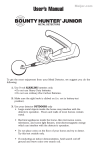
You can effectively detect in most soil conditions with the GROUND control in
the NORMAL position. As you sweep the coil from side-to-side, the detector is
constantly scanning the ground and self-adjusting to changing soil conditions.
Soils vary in their magnetic, conductive and alkaline properties. Soils vary by
region of the country, and can even vary within small areas; soil at the top of a
hill can be different from the soil in a nearby depression.
Automatic ground balancing requires a level, consistent coil sweep. Do not lift
the coil at the ends of your sweeps. Maintain a consistent coil speed as you
move the coil from side to side.
For increased detection efficiency in extreme soil conditions, you may want to
manually adjust the ground balance. If your detector emits excessive nonrepeatable signals, you may be detecting over magnetic, highly conductive or
alkaline soils. Most types of sand can be balanced with the GROUND control in
the 9:00 or 10:00 position. Clay and red-clay soil common to the Southeastern
U.S. can usually be balanced in the 11:00 to 4:00 positions.
GROUND BALANCE ADJUSTMENT
Move the search coil rapidly straight up
and down over the ground in a Yo-Yo
fashion. Do not sweep the coil during
this ground balance adjustment
process. Do not touch the coil to the
ground. Move the coil up and down
between 1 inch and 1 foot above the
ground.
Move the GROUND control to the left-most position at which the detector DOES
NOT beep while moving the coil up and down in a Yo-Yo fashion.
To verify the ground balance at any time in any ground condition, perform this
Yo-Yo test (move the coil up and down rapidly over the ground, without
touching the ground). If the detector remains quiet while doing the Yo-Yo test
(with the GROUND knob motionless, and a spot of ground which does not
contain metal), then your detector is ground balanced.
The detector may beep while turning the GROUND knob; this is normal.
Move the knob in small increments.
8