1
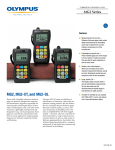
Powerful Performance in a Compact Flaw Detector
The EPOCH LTC offers many standard features to meet your inspection needs. These include a fixed width square wave pulser, dynamic
DAC/TVG, onboard DGS/AVG, selectable digital filters, gain range from 0 dB to 110 dB, peak memory, 0.01 mm (0.001 in.) measurement resolution, and one gate with programmable alarms. In addition, the EPOCH LTC offers many optional, application-specific software features such as AWS D1.1/D1.5 weld rating, manual PRF control, pulse width tuning, and the GageView Pro interface program.
• Standard fixed widthc square wave
pulser with PerfectSquare™ technology
• Digital receiver filtering: standard,
broadband, and high-pass settings
• Four, fully customizable measurement
displays to meet inspection needs.
Select any Gate measurement for each
display box
• Amplitude measurement resolution of
0.25% full screen height
• Auto-calibration for thickness,
soundpath, or angular depth
• Amplitude measurement from 0% to
110% full screen height
• PRF rate automatically controlled from
10 Hz to 500 Hz. Manual control is
optional
• Grid display modes
– Standard 1 to 10
– Soundpath
– Leg mode for angle beam inspection
– Selectable 100% or 110% vertical
display
Simplified Keypad Design
The EPOCH LTC features a simple keypad
design that allows full control with the left
or right hand for direct access to important
functions. The keypad design also makes
for rapid and easy parameter adjustments
and recall of instrument configuration
(CAL) files.
The keypad is available in English, international symbols, Japanese, and Chinese.
Four custom function keys allow operators to select preset values for instrument
configuration parameters.
Built for Tough Environments
The EPOCH LTC can withstand the rigors of field operation in
harsh environments, from offshore to deserts.
Environmental Ratings
IP rating
Designed to meet the standards of the Ingress
Protection (IP) rating number IP67
Explosive atmosphere
Safe operation as defined by Class I,
Division 2, Group D, as defined in the National Fire Protection Association Code (NFPA
70), Article 500, and tested using MIL-STD810F, Method 511.4, Procedure I.
Shock tested
IEC 60068-2-27; 60 g, 6 ms H.S., 3 axes,
18 shocks total
Vibration tested
Sine vibration as per IEC 60068-2-6; 50 Hz
to 150 Hz at 0.03 in. DA or 2 g, 20-sweep
cycles
Drop tested
MIL-STD-810F, 4.5.5 Procedure IV–Transit
drop. 48 in. drop onto 2 in. plywood surface
backed by concrete. Drop on each face, edge,
and corner for a total of 26 drops
Operating temperature
Lithium-ion: –10 °C to 50 °C (14 °F to 122 °F)
Battery storage
temperature
0 °C to 50 °C (32 °F to 122 °F)
Recharge temperature
range
0 °C to 40 °C (32 °F to 104 °F)
Battery compartment
Sealed – no tools necesssary to replace
battery
I/O door
Sealed I/O door for USB On-The-Go
connection, miniSD Card slot, and
VGA/RS-232 port
Hand strap can be moved for use
with left or right hand
2
www.olympus-ims.com