1
Cytoscape User Manual
XGMML is now preferred to GML because it offers the flexibility associated with all XML document
types. If you're unsure about which to use, choose XGMML.
SBML (Systems Biology Markup Language) Format
The Systems Biology Markup Language (SBML) is an XML format to describe biochemical networks.
SBML file format specification is available at:
http://sbml.org/documents/
BioPAX (Biological PAthways eXchange) Format
BioPAX is an OWL (Web Ontology Language) document designed to exchange biological pathways data.
Complete set of documents for this format is available at:
http://www.biopax.org/index.html
PSI-MI Format
The PSI-MI format is a data exchange format for protein-protein interactions. It is an XML document to
describe PPI and associated data. PSI-MI XML format specification is available at:
http://psidev.sourceforge.net/mi/xml/doc/user/
Delimited Text Table and Excel Workbook
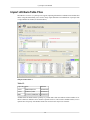
Cytoscape has native support for Microsoft Excel files (.xls) and delimited text files. The table in those
file can have network data and edge attributes. Users can specify columns for source node, target node,
interaction type, and edge attributes from GUI. For more detail, please read Import Free-Format Tables
section.
NODE NAMING ISSUES IN CYTOSCAPE
Typically, genes are represented by nodes, and interactions (or other biological relationships) are represented
by edges between nodes. For compactness, a gene also represents its corresponding protein. Nodes may
also be used to represent compounds and reactions (or anything else) instead of genes.
If a network of genes or proteins is to be integrated with Gene Ontology (GO) annotation or gene expression
data, the gene names must exactly match the names specified in the other data files. We strongly encourage
naming genes and proteins by their systematic ORF name or standard accession number; common names
may be displayed on the screen for ease of interpretation, so long as these are available to the program in
the annotation directory or in a node attribute file. Cytoscape ships with all yeast ORF-to-common name
mappings in a synonym table within the annotation/ directory. Other organisms will be supported in the
future.
Why do we recommend using standard gene names? All of the external data formats recognized by Cytoscape provide data associated with particular names of particular objects. For example, a network of proteinprotein interactions would list the names of the proteins, and the attribute and expression data would likewise
be indexed by the name of the object.
The problem is in connecting data from different data sources that don't necessarily use the same name for
the same object. For example, genes are commonly referred to by different names, including a formal
"location on the chromosome" identifier and one or more common names that are used by ordinary research-
26