1
DRAFT COPY – DO NOT DISTRIBUTE
25.2 - the number of chemisorbed surface species (ncomp(2)) (I)
This is the number of species considered to be chemisorbed on the surface. The sum
of the surface concentrations of these species and the vacant site concentration must
add to the total site concentration (sitec).
25.3 - the number of physisorbed species (ncomp(3)) (I)
The chemisorbed species and physisorbed species are tracked differently, because the
sum of the surface fractions of chemisorbed species and the vacant species should
add to one. No such constraint is placed on the physisorbed species.
25.4 - the number of solid phase products (ncomp(4)) (I)
This should be no more than the number of reactions, since each reaction is assumed
to produce no more than one solid product.
25.5 - the number of solid materials present (ncomp(5)) (I)
A value should be entered here, and it is checked against the number of materials in
the original substrate and the materials formed by the reactions-- not the solid phases
formed by the reactions, but rather the materials that these solid phases make up. In
many cases, these are the same, but not necessarily (see EX.4.WSI).
25.6- the number of reactions (nreact) (I)
This is the number of reactions that occur.
BLOCK 26
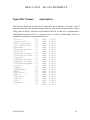
Contains the names of the ballistic species or collision species in the high-pressure case
(spname) (C), in single quotes and up to 25 characters in length. Thus, this block contains
ncomp(1) entries, on one or more lines. See examples.
EVOLVE5.0i.a
34