1
WARNING
WARNING-Continued
• Compressors, storage cylinders, valves, regulators, fittings, and other hardware must be large
enough to deliver the air volume required by all
users at peak demand.
• You are responsible for air quality and compliance
with safety and heal codes applicable to our area.
• See the tales in section VII for hose length, air
supply pressure, and quick coupler requirements.
• Do not mix hose types or coupler assemblies
except as specified in the tables in section VII.
• Be sure that all respirable air system piping, tubing, fittings, and couplings are incompatible with
non-respirable gas systems.
• If an air pump or compressor is used to supply
breathing air, the following precautions must be
taken:
a. The air pump or compressor intake must not be
located in an area that could possibly contain air
contaminant's, such as but not limited to engine
exhaust, spray booth exhaust, or other toxic gases.
b. The air pump or compressor must have in take
and exhaust filters capable of removing dirt, carbon
dust, oil, oil vapor, and excess water mist that may
be present in the area of the
intake or maybe generated within the air pump or
compressor itself. Carbon monoxide alarms should
be installed on oil- lubricated compressors and in
any other situation where carbon monoxide may be
present.
c. Frequently test the purity of the air delivered by
the air pump or compressor. Air pumps and compressors deteriorate with age, and so does the
quality of the air they deliver.
d. Set the pressure regulator and/or relief valve to
maintain the pressure within the range specified in
the tables in section VII.
• Users must clean and maintain this respirator only
in accordance with SAS SAFETY's instructions.
Accessories not offered by SAS SAFETY may
degrade performance, and will void NIOSH certification.
• The respirator facepiece assembly contains natural rubber latex which may cause allergic reactions
in some individuals. Discontinue use if you experience an allergic reaction.
• Discontinue use if you experience skin irritation or
discoloration.
• FAILURE TO OBSERVE ALL WARNINGS MAY
RESULT IN PERSONAL INJURY, SERIOUS ILLNESS, OR DEATH.
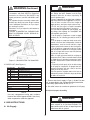
Figure 1. Continuous Flow Full Hood SAR
IV. PARTS LIST (See Figure 1)
Item
1
2
3
4
5
6
7
Part No.
9816-01
9816-10
9817-25
9816-20
9818-20
9852-24
9813-21
Description
Full Hood
Standard Suspension
Hood SAR Breathing Tube with Muffler
Hood SAR Belt
Lens Covers (Pkg. of 10)
Hose Clip
1/4” NPT Threaded Plug
1. Ensure that the air supply is Type 1, Grade D or better, as described in the Compressed Gas Association
Commodity Specification for Air, G-7.1.
Air Line Hoses 3/8 in.
Light Weight w/ OBAC Couplings Length (Feet)
9852-41
25
9852-42
50
9852-44
100
2. Set relief valves at a maximum pressure of 125 psig.
B. Quick Coupler Assembly
NOTE
Use only components having part numbers
listed on the NIOSH approval label. Use of any
other components voids the approval.
WARNING
Do not use pipe thread sealing tape on the
quick coupler or air line hose threads. The
tape could restrict air flow, or tape fragments
could enter the air system.
V. USE INSTRUCTIONS
A. Air Supply
3