1
1. Introduction
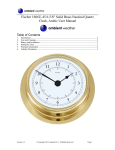
Fischer 1508TH-45 5" Polished Brass Marine Thermo-Hygrometer. The following is a guide for
preparation, care and operation of your marine weather instrument.
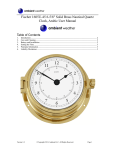
Note: Some of the images are generic and may not match your exact model.
2. Care and Cleaning
Avoid use of harsh household cleaners and coarse paper towels, which can scratch the bezel or lens.
Fingerprints and dirt may be removed the lenses and bezels with a soft cloth lightly dampened with a
mixture of water and mild dishwashing liquid. Be sure to dry the lens and bezel with a soft cloth
after cleaning.
3. Thermo-hygrometer
3.1 How the hygrometer works
The hygrometer measures the indoor relative humidity. The sensor measures the air moisture by a
sensitive mechanical coil spring that is bonded with a moisture absorbent material.
Hygrometers register the percentage of water vapor present in the air, compared to the maximum
amount that can be present at a given temperature.
The coils in hygrometers respond slowly and while humidity levels change abruptly, it can take an
hour or more for the meter to reach an accurate reading. Remember that the hygrometer is reading
indoor humidity, and is vastly different than outdoor humidity, as reported by the National Weather
Service.
It is not uncommon to have low humidity reading during cold weather when indoor air is heater. Air
conditioning also removes moisture from the air. The optimum levels are 45% to 50% during
heating and cooling seasons. Low humidity can cause health problems and can be hard on wood
furnishings. High humidity can cause mold or mildew to grow.
3.2 Hygrometer Accuracy
Humidity measurement is among the more difficult problems in basic meteorology. Accuracy is
difficult to achieve and are subject to drift.
A further difficulty is that most hygrometers sense relative humidity rather than the absolute amount
of water present, but relative humidity is a function of both temperature and absolute moisture content,
so small temperature variations within the air in a test chamber will translate into relative humidity
variations.
4.3 Dial Thermometer
The dial thermometer uses a bimetallic strip wrapped into a coil. One end of the coil is fixed to the
housing of the device and the other drives an indicating needle. The principle behind a bimetallic strip
thermometer relies on the fact that different metals expand at different rates as they warm up. By
bonding two different metals together, the coil bends, causing the needle to move. Bimetallic
thermometers are not as accurate as bulb (mercury or red spirit) thermometers. The dial thermometer
Version 1.0
©Copyright 2013, Ambient LLC. All Rights Reserved.
Page 2