1
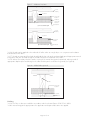
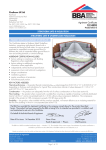
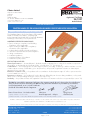
Figure 1 Junctions between roofs and walls
breather membrane
low emissivity air space
Celotex PIR insulation
below rafter
Celotex PIR insulation
between rafter
void filled with
insulation meeting
an R-value of
2
1.2 m KW
Celotex PIR cavity
wall insulation
Existing buildings
5.6 For existing buildings, in work such as extensions and conversions, roofs will be acceptable where they do not
exceed the relevant U values given in section 5.3, and junctions and openings comply with section 5.6 or BRE Report
(BR 262 : 2002) Thermal insulation: avoiding risks.
6 Condensation
Interstitial condensation
6.1 Roofs will adequately limit the risk of interstitial condensation when they are designed and constructed in
accordance with BS 5250 : 2002, Section 8.4 and Appendix D.
6.2 The risk of interstitial condensation will be minimal under normal conditions of use. The foil facings have a water
vapour resistance exceeding 70 MN·s·g–1 and the insulation core has a water vapour resistivity of 300 MN·s·g–1m–1
and, when installed with tightly butted joints, filled/sealed gaps and joints, will provide a continuous convection-free
envelope of high vapour resistance. Therefore, a suitable vapour-permeable, roof tile underlay may be laid over the
insulation boards without ventilated air space. When using a high resistance (type HR) underlay, the space below it
must be ventilated in accordance with BS 5250 : 2002, Section 8.4.
6.3 Where the product is installed in a roof with either a horizontal or sloping ceiling (ie room-in-the-roof), a ‘warm
roof’ space is created and ventilation is not required. However, any insulation in a horizontal ceiling should be
removed.
6.4 Where high humidity may be expected, a vapour control layer should also be used unless a condensation risk
analysis in accordance with BS 5250 : 2002 shows that it is not necessary.
Surface condensation
6.5 Roofs will adequately limit the risk of surface condensation when the thermal transmittance (U value) does
not exceed 0.35 W·m–2·K–1 at any point and the junctions with walls are designed in accordance with the
relevant requirements of Limiting thermal bridging and air leakage : Robust construction details for dwellings and
similar buildings, TSO 2002 or BRE Information Paper IP 1/06 Assessing the effects of thermal bridging at junctions
and around openings.
6.6 Roofs will adequately limit the risk of surface condensation when the thermal transmittance (U value) does
not exceed 1.2 W·m–2·K–1 at any point. Guidance may by obtained from BS 5250 : 2002, Section 8, and
BRE Report (BR 262 : 2002).
7 Behaviour in relation to fire
7.1 When installed between, under or over rafters the product will be contained between the roof and internal lining
board until one is destroyed. Therefore, the insulation will not contribute to the development stages of a fire or present a
smoke or toxic hazard.
Page 6 of 12